It's a live deck. Press start, then scroll or use the arrow keys, or play it full screen.
Play the 2026 deckApollo 11's narrative memo and PR/FAQ, slide by slide
-
 01We wrote the landing first.
 -
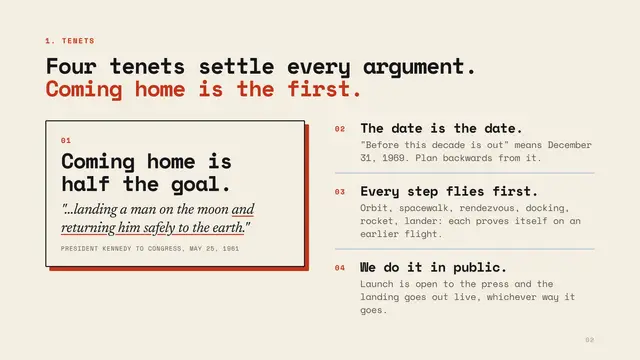 02Four tenets settle every argument. Coming home is the first.
 -
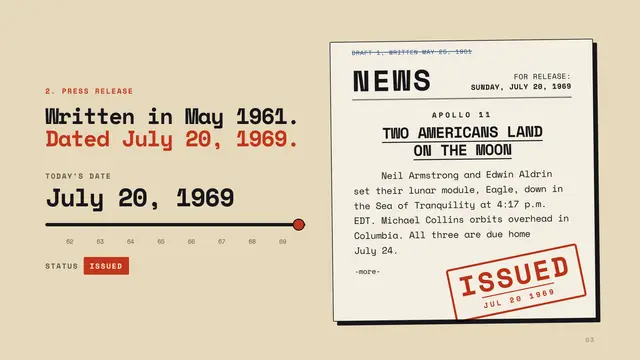 03Written in May 1961. Dated July 20, 1969.
 -
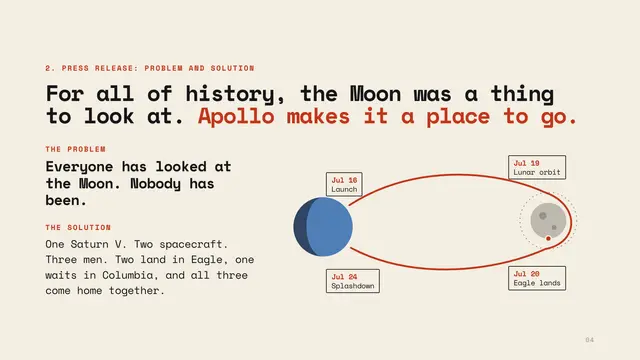 04For all of history, the Moon was a thing to look at. Apollo makes it a place to go.
 -
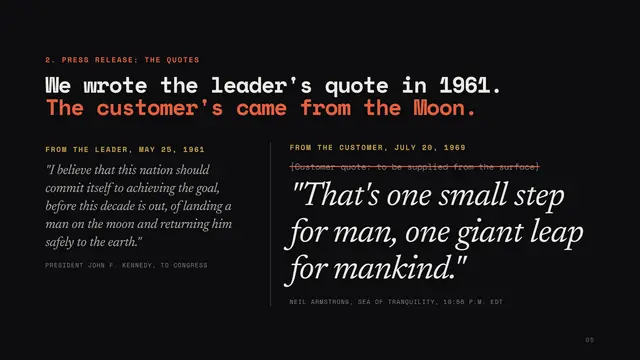 05We wrote the leader's quote in 1961. The customer's came from the Moon.
 -
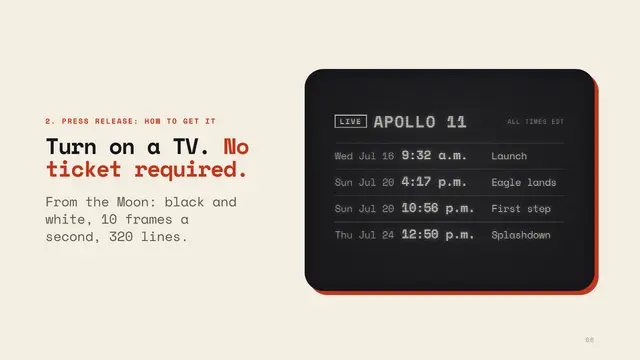 06Turn on a TV. No ticket required.
 -
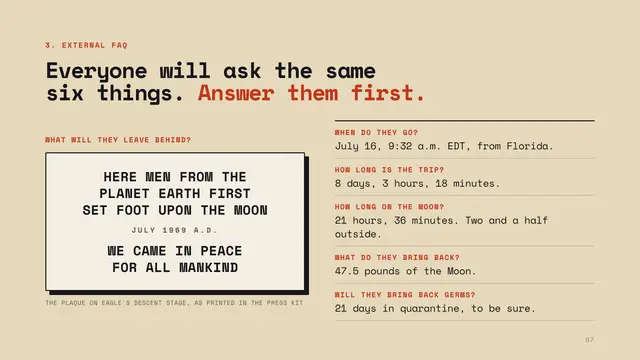 07Everyone will ask the same six things. Answer them first.
 -
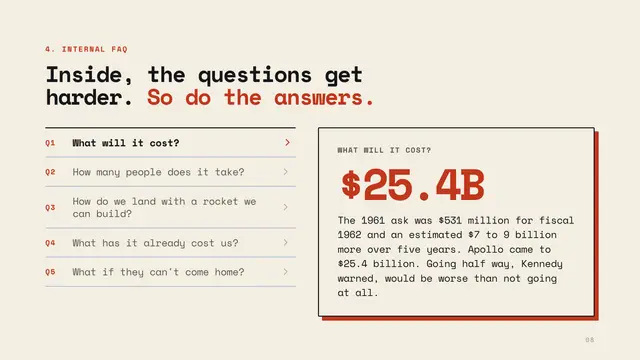 08Inside, the questions get harder. So do the answers.
 -
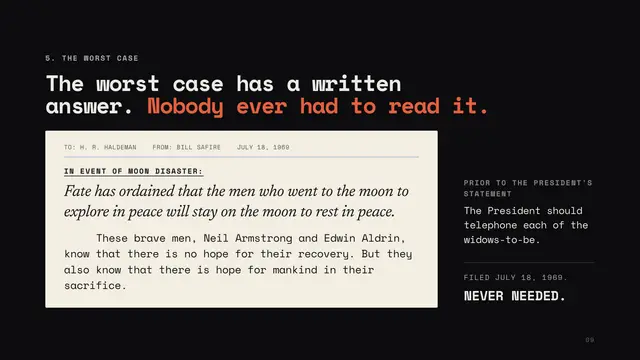 09The worst case has a written answer. Nobody ever had to read it.
 -
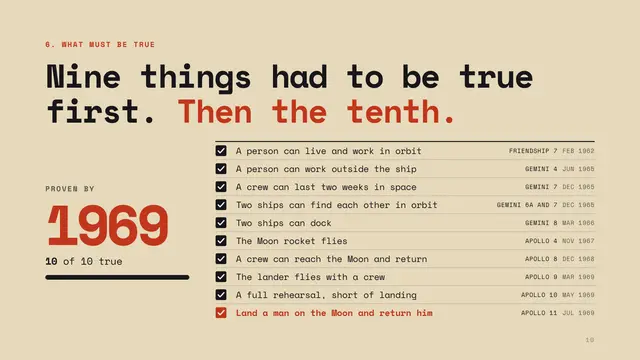 10Nine things had to be true first. Then the tenth.
 -
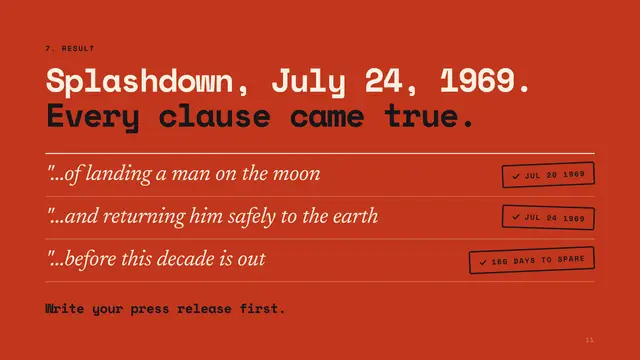 11Splashdown, July 24, 1969. Every clause came true.
Then · 1969
How it really went
Read the real storyIn Event of Moon Disaster, National Archives (with NASA's Apollo 11 press kit) ↗- May 25, 1961: Kennedy asks Congress for a man on the Moon, returned safely, before the decade is out
- Mercury and Gemini prove orbit, spacewalks, rendezvous and docking, 1962 to 1966
- January 1967: the Apollo 1 crew dies in a launch pad fire
- Saturn V flies; Apollo 8, 9 and 10 rehearse every step but the landing
- July 6, 1969: NASA issues the Apollo 11 press kit: "Perform a manned lunar landing and return"
- July 16: launch, 9:32 a.m. EDT
- July 18: Safire writes "In Event of Moon Disaster" for the President
- July 20: Eagle lands at 4:17 p.m.; the first step goes out live at 10:56 p.m.
- July 24: splashdown in the Pacific; the speech is never needed
Now · 2026 · 11 slides
What we changed
- The release stamps itselfDrag the date from May 25, 1961. The press release stays a draft for eight years, then slams down ISSUED on July 20, 1969.
- Present it or read itOne switch (or the M key) turns every slide into the typed six-page memo, so the same deck works in the meeting and in silence before it.
- An internal FAQ you openCost, people, the lunar orbit bet, Apollo 1, and the worst case: open each question and get the answer, $25.4 billion and all.
- What must be true, tickedTen prerequisites from Friendship 7 to Apollo 11 check themselves off in the order they flew, with the year counting up beside them.
Steal the structure
Build your narrative memo and pr/faq like Apollo 11 did.
- 01 Memo header Name the document, the author, the date drafted and the date of the release, and how to read it.
- 02 Tenets Three to five rules that settle the arguments before they start; one is the hero.
- 03 Headline and subhead The press release for launch day, dated: who gets what, and the one-sentence result.
- 04 Problem and solution The customer's problem in one line, the solution in three, with a picture of how it works.
- 05 The quotes One quote from the leader on why, one from the customer on what it's like.
- 06 How to get it Where, when and what it costs the customer: the call to action.
- 07 External FAQ The five or six questions customers and press will ask, one line each.
- 08 Internal FAQ Cost, people, the hard technical bet and what it has already cost, one answer at a time.
- 09 The worst case What we will do and say if it fails, written down before launch.
- 10 What must be true The prerequisites in the order they must be proven, ticked off as they are.
- 11 Result Close on the goal, clause by clause, and what came true.
Make yours in ChatGPT
Type your site. We'll write the prompt with Apollo 11's structure and your brand.