It's a live deck. Press start, then scroll or use the arrow keys, or play it full screen.
Play the 2026 deckGustave Eiffel's client proposal, slide by slide
-
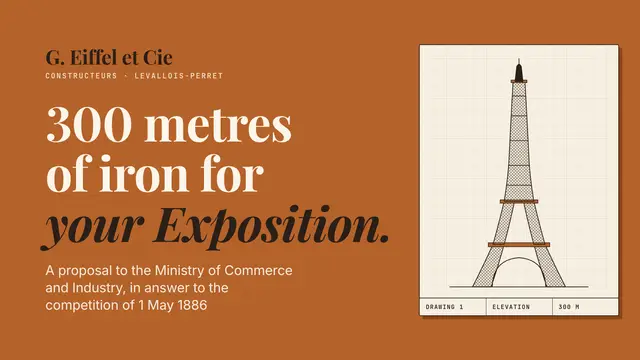 01300 metres of iron for your Exposition.
 -
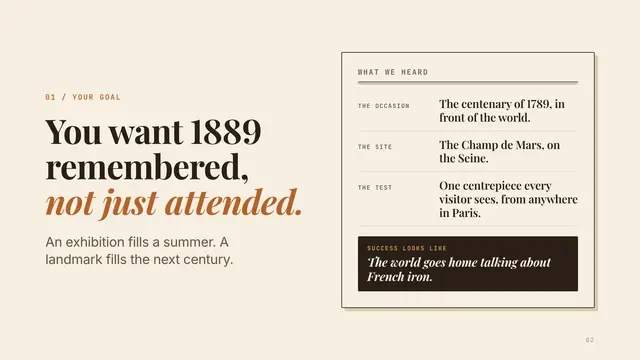 02You want 1889 remembered, not just attended.
 -
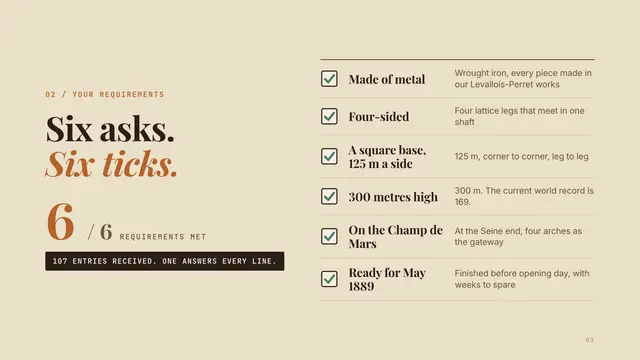 03Six asks. Six ticks.
 -
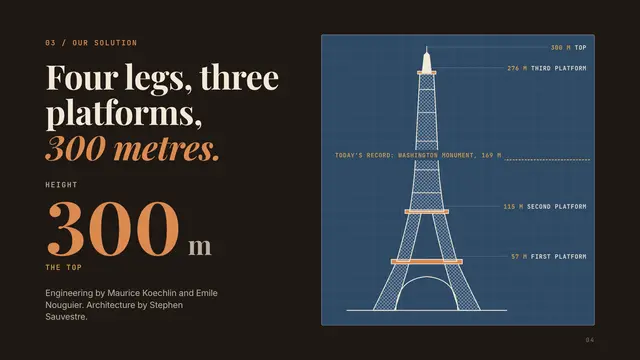 04Four legs, three platforms, 300 metres.
 -
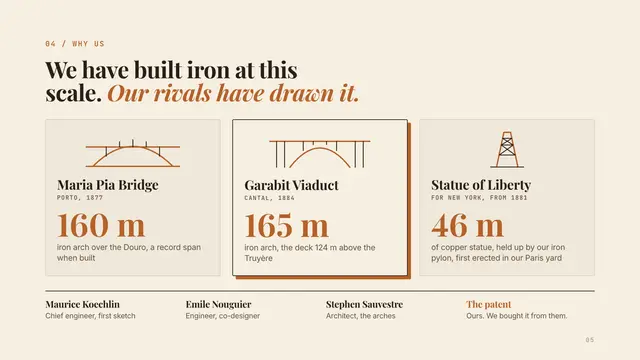 05We have built iron at this scale. Our rivals have drawn it.
 -
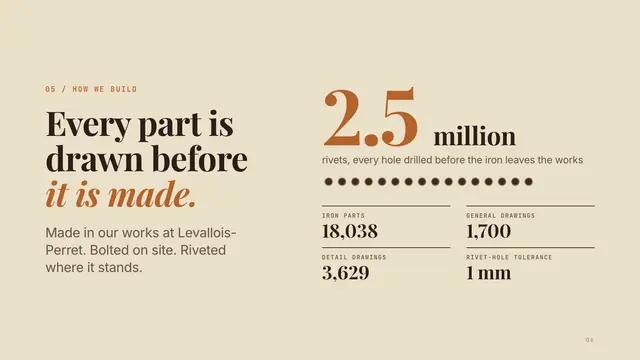 06Every part is drawn before it is made.
 -
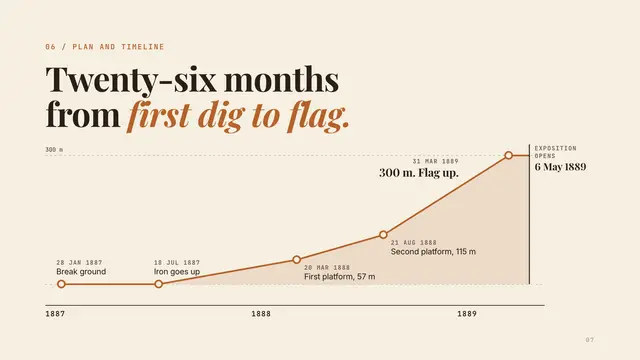 07Twenty-six months from first dig to flag.
 -
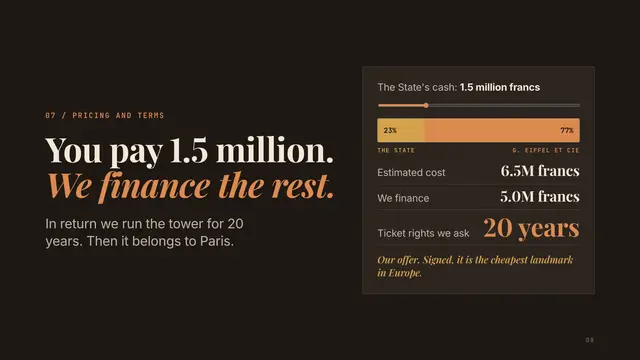 08You pay 1.5 million. We finance the rest.
 -
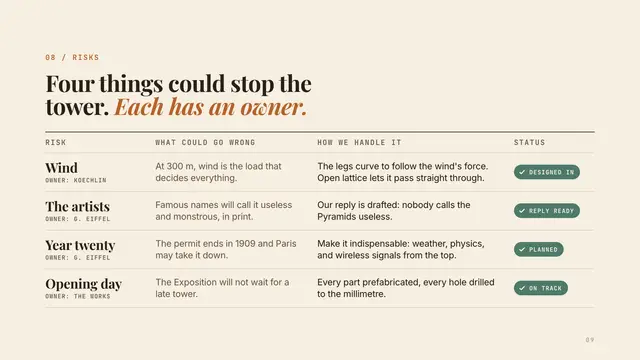 09Four things could stop the tower. Each has an owner.
 -
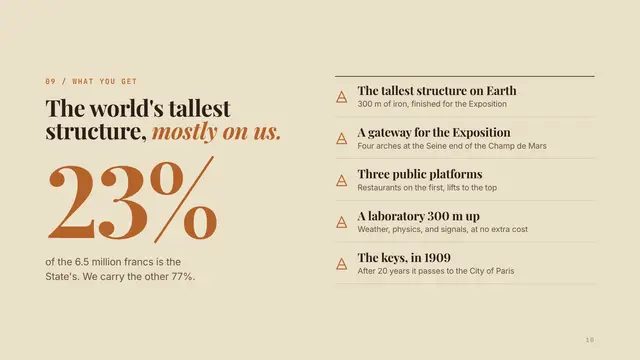 10The world's tallest structure, mostly on us.
 -
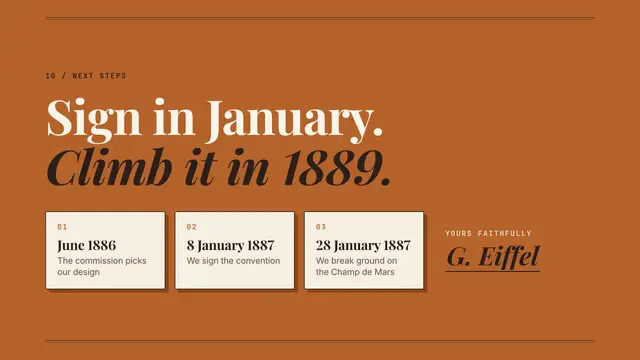 11Sign in January. Climb it in 1889.
Then · 1886
How it really went
Read the real storythe story, via Wikipedia ↗- Koechlin and Nouguier sketch a 300 m iron pylon (1884)
- Sauvestre adds the arches and the glass pavilion
- Eiffel buys the patent rights from his engineers
- May 1886: the State opens a competition for the 1889 Exposition
- 107 entries; the commission picks Eiffel's
- January 1887: the State pays 1.5M francs; Eiffel finances the rest for 20 years of revenue
- February 1887: artists protest the "useless and monstrous" tower in Le Temps
- 18,038 parts and 2.5 million rivets go up in two years, two months and five days
- March 1889: Eiffel raises the flag at 300 m, the tallest structure on Earth
- Due to come down after 20 years; radio saves it
Now · 2026 · 11 slides
What we changed
- The brief ticks itself offAll six lines of the 1886 competition, from "metal" to "ready for May 1889", answered and checked in order, with a 6 of 6 score.
- The tower builds to scaleA blueprint elevation assembles section by section while a height counter climbs past the Washington Monument to 300 m.
- The deal is a sliderMove the State's cash between nothing and all 6.5 million francs and watch Eiffel's financing and the years of ticket rights move with it, anchored on the real 1.5 million for 20 years.
- The protest is a line itemWind, the artists in Le Temps, the 1909 teardown, and opening day each get an owner and a mitigation in the risk register.
Steal the structure
Build your client proposal like Gustave Eiffel did.
- 01 Cover Who you are, what you will deliver, and the brief you are answering.
- 02 Your goal Play the client's objective back to them, including what success looks like.
- 03 Your requirements Quote each requirement in their order and show how you meet it.
- 04 Our solution The thing you will deliver, shown, with its headline number.
- 05 Why us Comparable work you have already delivered, and the named team.
- 06 How we build The method that makes the plan believable.
- 07 Plan and timeline Dated milestones the client can hold you to, ending before their deadline.
- 08 Pricing and terms What they pay, what you carry, and what you get in return.
- 09 Risks A register with an owner, a mitigation, and a status for each risk.
- 10 What you get What the client holds at the end, not the work you will do.
- 11 Next steps Three dated actions and a signature.
Make yours in ChatGPT
Type your site. We'll write the prompt with Gustave Eiffel's structure and your brand.