The 2002 Oakland A's: The Moneyball business case

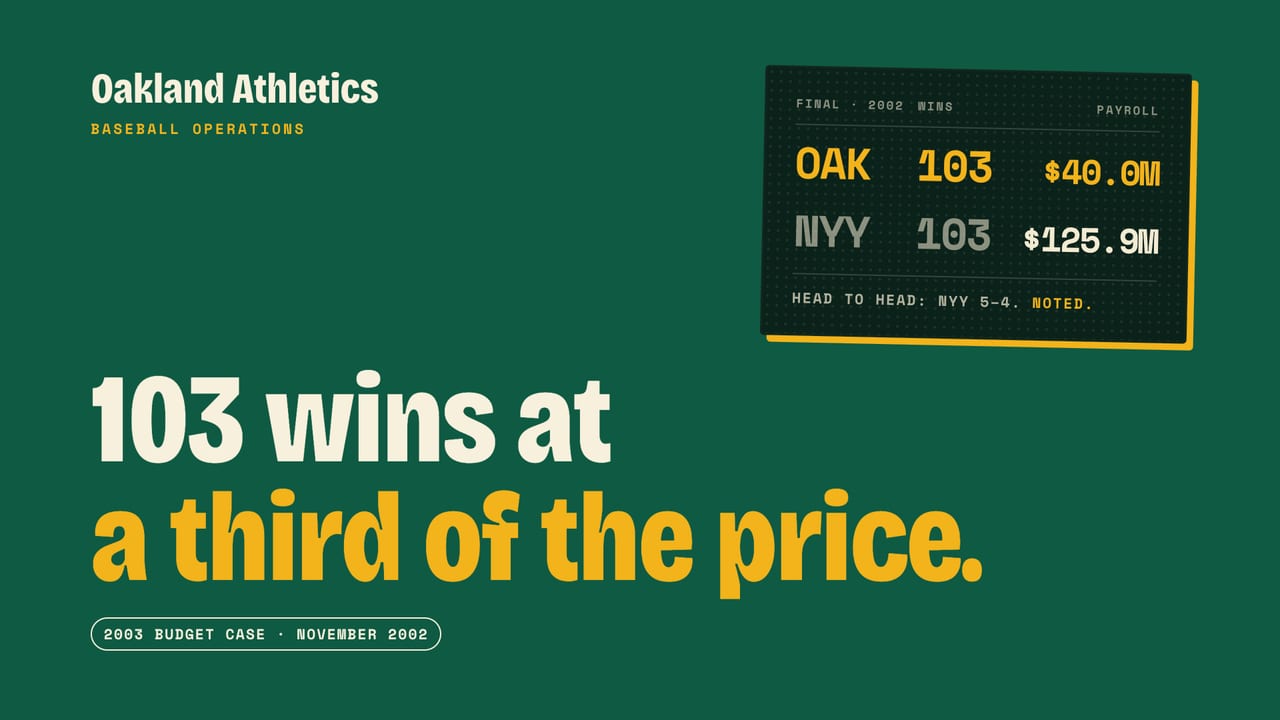
103 wins at a third of the price. ROI business case, 2002, rebuilt as a live deck you can play and steal. More in Templates, sales.

The 2002 Oakland A's deck, first slide Play the deck
  • 11 slides
  • $40.0M payroll
  • 103 wins
  • 20 straight

Steal the ROI business case structure

11 slides, one job each, in this order. Swap in your story and keep the order.

  1. 01
    Headline outcomeThe result and the price on one line, before anything else.
  2. 02
    The decisionThe one approval you need today, with the unit economics that justify it.
  3. 03
    Cost of the status quoWhat standing still costs, in the buyer's own currency.
  4. 04
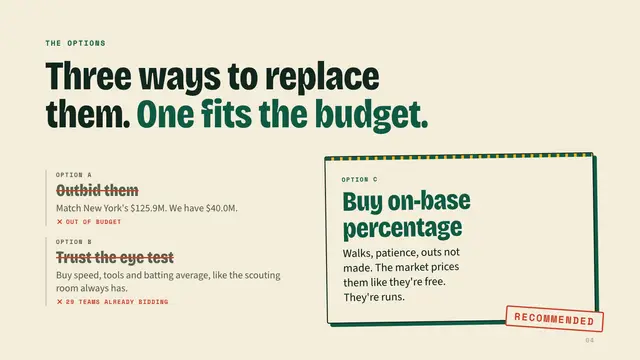
    OptionsEvery real alternative, including doing nothing, with why it fails. One recommended.
  5. 05
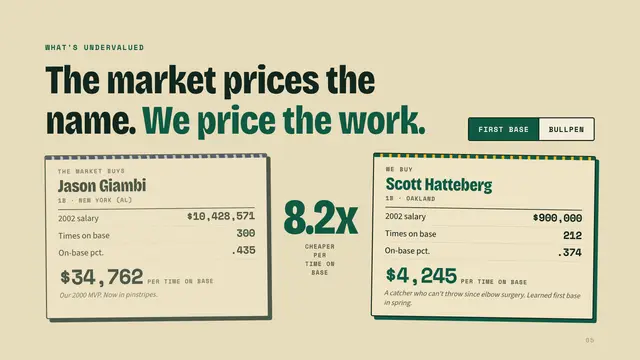
    The insightWhat the market misprices, shown with like-for-like unit costs.
  6. 06
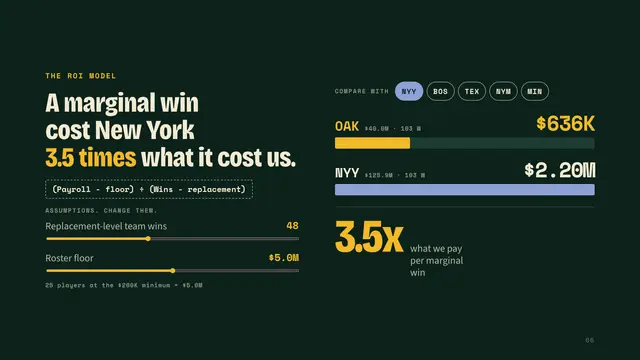
    ROI modelThe formula, its assumptions as controls, and the result the buyer drives.
  7. 07
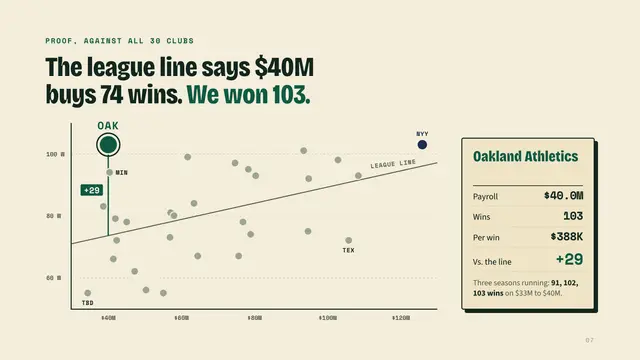
    Proof from lookalikesYour result plotted against every peer, with the trend line drawn.
  8. 08
    Results to dateThe moment that made it undeniable, told as a sequence.
  9. 09
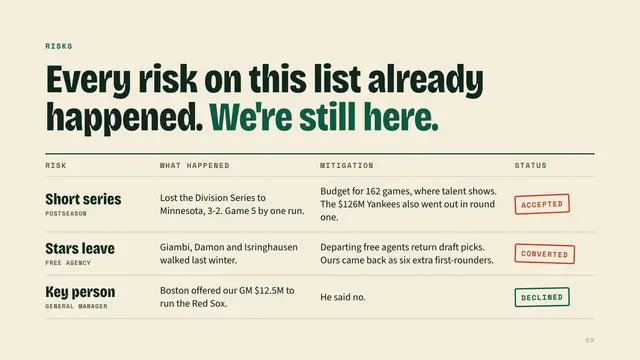
    RisksA register: what could go wrong, what you will do, and its status.
  10. 10
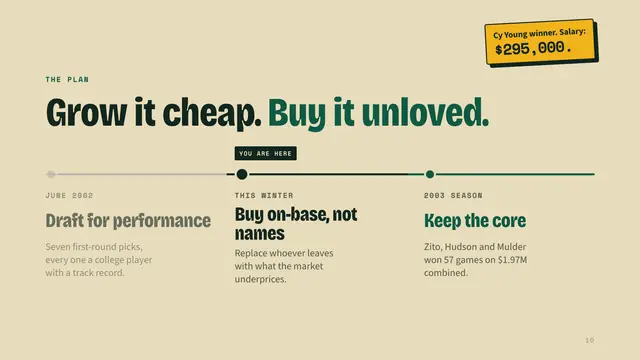
    The planPast, now and next on one line, with where we are pinned.
  11. 11
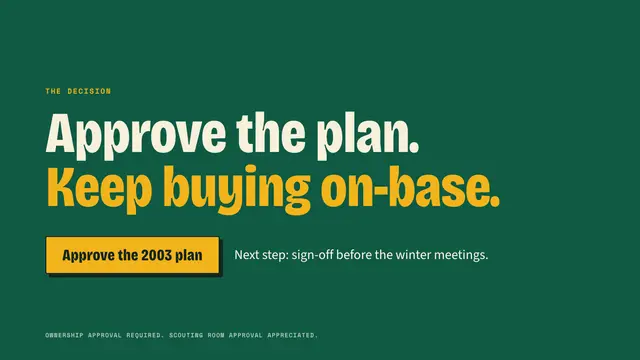
    Decision and next stepThe ask restated, one button, and the date it is needed by.
What good sales do, and where they fail
  • Open on a big shift in the buyer's world, not on your company (Raskin's strategic narrative).
  • On discovery calls, slides cost follow-ups: Gong found reps who used them were 17% less likely to book the next meeting. Ask, then show.
  • Winners spend less time on the deck (9.1 vs 11.4 minutes in intro calls) and 39% less on features (Gong).
  • Use proof from customers like the buyer; generic logos and ROI claims hurt (Gong).
  • End on a mutual action plan with dates and owners on both sides, never "Thank you".
  • Starting with the company history
  • A feature tour
  • Logos from the wrong industry
  • No next step with a date

The deck, slide by slide

Each one opens the live deck at that slide.

  1. The 2002 Oakland A's deck, slide 1: 103 wins at a third of the price. 01103 wins at a third of the price.
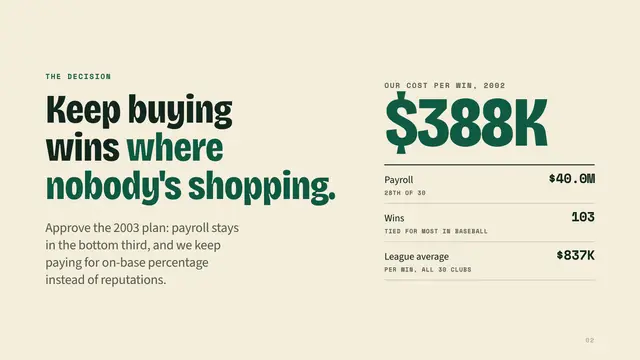
  2. The 2002 Oakland A's deck, slide 2: Keep buying wins where nobody's shopping. 02Keep buying wins where nobody's shopping.
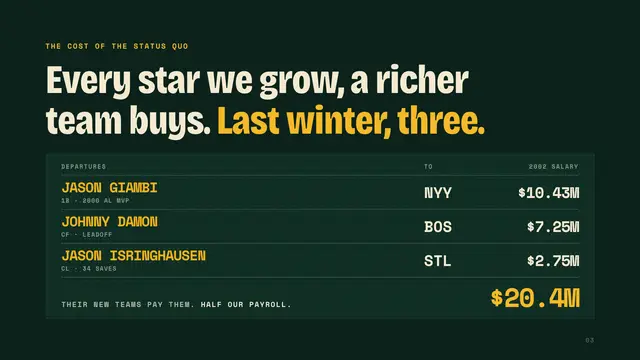
  3. The 2002 Oakland A's deck, slide 3: Every star we grow, a richer team buys. Last winter, three. 03Every star we grow, a richer team buys. Last winter, three.
  4. The 2002 Oakland A's deck, slide 4: Three ways to replace them. One fits the budget. 04Three ways to replace them. One fits the budget.
  5. The 2002 Oakland A's deck, slide 5: The market prices the name. We price the work. 05The market prices the name. We price the work.
  6. The 2002 Oakland A's deck, slide 6: A marginal win cost New York 3.5 times what it cost us. 06A marginal win cost New York 3.5 times what it cost us.
  7. The 2002 Oakland A's deck, slide 7: The league line says $40M buys 74 wins. We won 103. 07The league line says $40M buys 74 wins. We won 103.
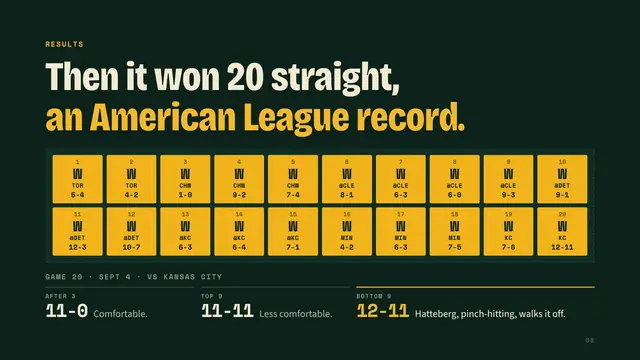
  8. The 2002 Oakland A's deck, slide 8: Then it won 20 straight, an American League record. 08Then it won 20 straight, an American League record.
  9. The 2002 Oakland A's deck, slide 9: Every risk on this list already happened. We're still here. 09Every risk on this list already happened. We're still here.
  10. The 2002 Oakland A's deck, slide 10: Grow it cheap. Buy it unloved. 10Grow it cheap. Buy it unloved.
  11. The 2002 Oakland A's deck, slide 11: Approve the plan. Keep buying on-base. 11Approve the plan. Keep buying on-base.
What really happened, and what the 2026 rebuild changes

What really happened, 2002

  1. After 2001, Giambi, Damon and Isringhausen leave for richer clubs
  2. Billy Beane and Paul DePodesta rebuild around on-base percentage
  3. Scott Hatteberg, a catcher who can no longer throw, moves to first base
  4. Submariner Chad Bradford anchors a bullpen bought on the cheap
  5. Opening Day payroll: $40.0M, against the Yankees' $125.9M
  6. A 20-26 start, then a 16-1 run in June
  7. 20 straight wins, an American League record
  8. Hatteberg ends game 20 with a pinch-hit walk-off
  9. 103 wins and the AL West; Zito wins the Cy Young, Tejada the MVP
  10. Out in the Division Series to Minnesota, 3-2
  11. Boston offers Beane its GM job; he says no

Read the real story the season, via Wikipedia and Baseball-Reference

What the rebuild changes

  • The ROI model has visible assumptions. Slide replacement-level wins and the roster floor, pick a rival, and watch the cost of a marginal win: $636K for Oakland, $2.20M for the Yankees.
  • All 30 clubs on one chart. Payroll against wins for every 2002 team. The league line says $40M buys 74 wins. Oakland sits 29 above it.
  • Baseball cards price the work. Flip between first base and the bullpen: Hatteberg got on base for $4,245 a time, Giambi for $34,762. Bradford recorded outs at $1,040 each.
  • The streak lights the scoreboard. Twenty lamps, twenty real scores, and game 20 told in three frames: 11-0, 11-11, Hatteberg.

Make yours in ChatGPT

Type your site. We'll write the prompt with The 2002 Oakland A's structure and your brand.