Barbie: Ruth Handler's pitch to Mattel

The doll is the razor. The wardrobe is the blade. New product pitch, 1959, rebuilt as a live deck you can play and steal. More in Templates, proposals and business cases.

Barbie deck, first slide Play the deck
  • 10 slides
  • $3 doll
  • 22 outfits
  • March 9, 1959

Steal the new product pitch structure

10 slides, one job each, in this order. Swap in your story and keep the order.

  1. 01
    CoverName the product and its promise in one line, with the product drawn, not described.
  2. 02
    Customer insightThe behavior you saw, in the customer's own words or play, before any product.
  3. 03
    Who it's forSeparate the user, the buyer and the gatekeeper; make the user the hero.
  4. 04
    EvidenceShow the behavior already exists, in a chart that compares today's options.
  5. 05
    Field researchThe proof you went and got yourself: what you bought, tested or saw elsewhere.
  6. 06
    The productSpecs, price and what sells separately, set like a catalog page.
  7. 07
    Objection and answerSay leadership's objection out loud before they do, then answer it with proof.
  8. 08
    How we reach customersThe channel you already own, and why it beats the industry default.
  9. 09
    EconomicsA live model of the first sale and the repeat sales, with the assumptions visible.
  10. 10
    The askA production run, a price and a launch date, plus a forecast you'll be held to.
What good proposals and business cases do, and where they fail
  • Start with their goal in their words, not your company.
  • Check off every requirement in the brief, visibly.
  • Put the decision on the first slide: what you are asking them to approve.
  • Show the options you considered and why this one wins.
  • Cost, phasing, and terms in one place; risks each with an owner; next steps with a date.
  • A credentials deck instead of an answer
  • Missing a requirement from the brief
  • Price hidden or vague
  • No decision asked for

The deck, slide by slide

Each one opens the live deck at that slide.

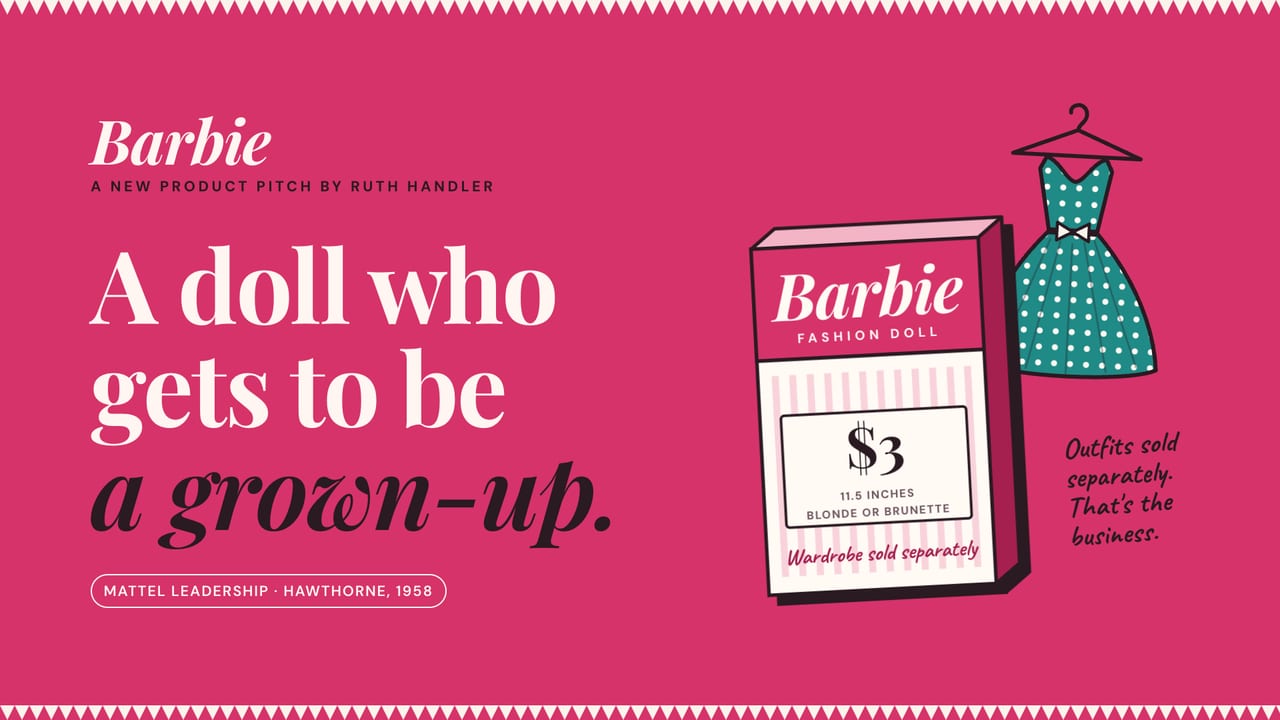
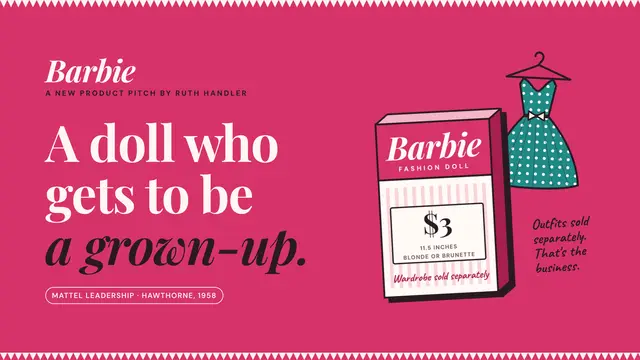
  1. Barbie deck, slide 1: A doll who gets to be a grown-up. 01A doll who gets to be a grown-up.
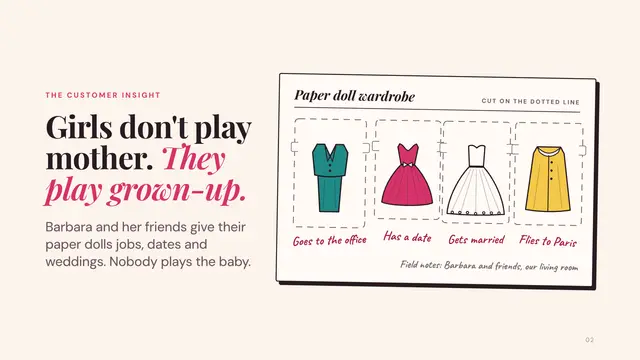
  2. Barbie deck, slide 2: Girls don't play mother. They play grown-up. 02Girls don't play mother. They play grown-up.
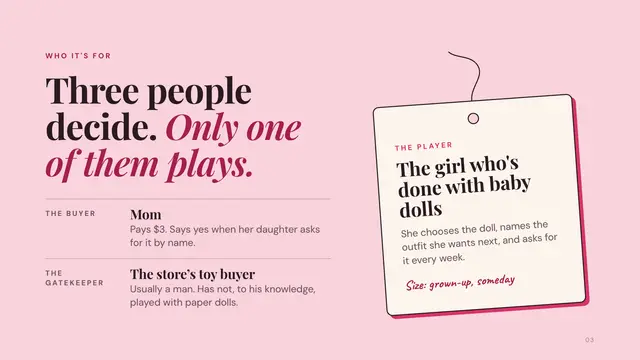
  3. Barbie deck, slide 3: Three people decide. Only one of them plays. 03Three people decide. Only one of them plays.
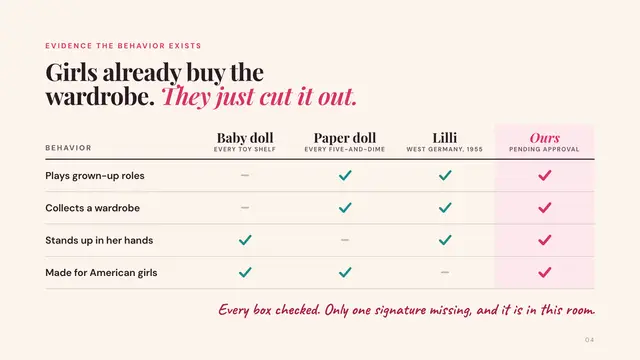
  4. Barbie deck, slide 4: Girls already buy the wardrobe. They just cut it out. 04Girls already buy the wardrobe. They just cut it out.
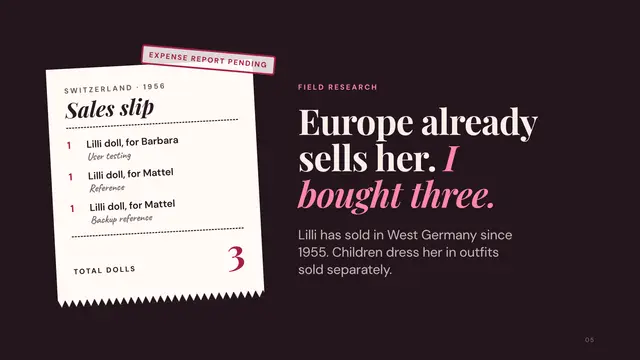
  5. Barbie deck, slide 5: Europe already sells her. I bought three. 05Europe already sells her. I bought three.
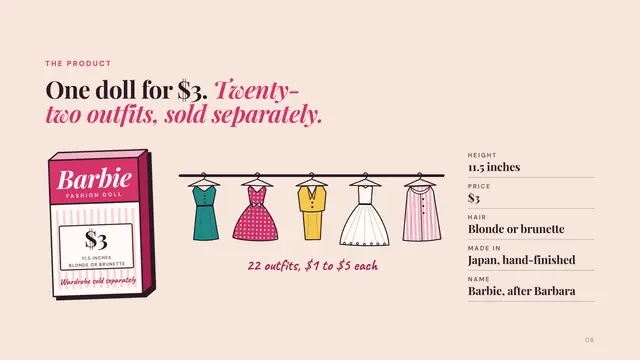
  6. Barbie deck, slide 6: One doll for $3. Twenty-two outfits, sold separately. 06One doll for $3. Twenty-two outfits, sold separately.
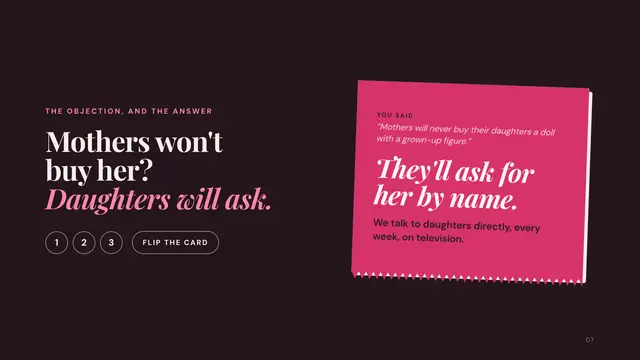
  7. Barbie deck, slide 7: Mothers won't buy her? Daughters will ask. 07Mothers won't buy her? Daughters will ask.
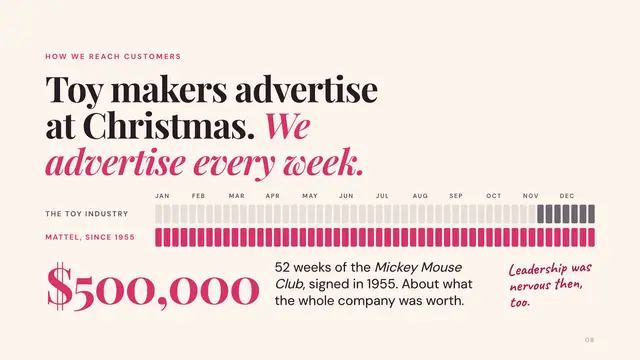
  8. Barbie deck, slide 8: Toy makers advertise at Christmas. We advertise every week. 08Toy makers advertise at Christmas. We advertise every week.
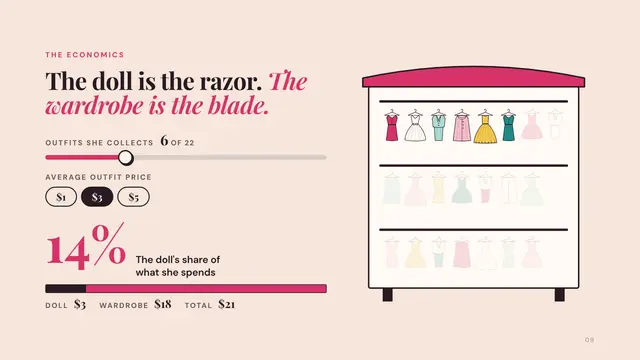
  9. Barbie deck, slide 9: The doll is the razor. The wardrobe is the blade. 09The doll is the razor. The wardrobe is the blade.
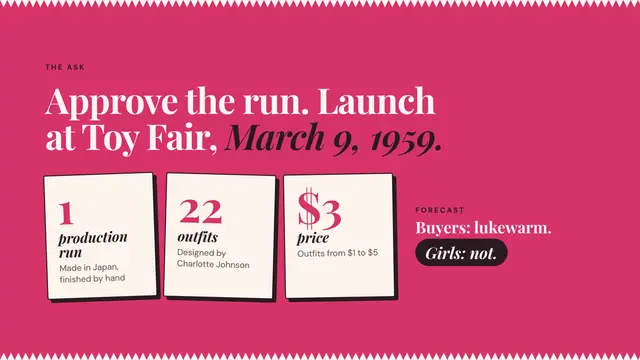
  10. Barbie deck, slide 10: Approve the run. Launch at Toy Fair, March 9, 1959. 10Approve the run. Launch at Toy Fair, March 9, 1959.
What really happened, and what the 2026 rebuild changes

What really happened, 1959

  1. Ruth watches Barbara give her paper dolls grown-up roles
  2. Mattel's male designers and executives say mothers will never buy it
  3. Mattel sponsors the Mickey Mouse Club in 1955: toy ads all year, not just at Christmas
  4. In Switzerland in 1956 Ruth finds Bild Lilli and buys three
  5. She redesigns the doll with Jack Ryan; it is made in Japan
  6. Charlotte Johnson designs 22 outfits, $1 to $5, sold separately
  7. Barbie debuts at the American International Toy Fair, New York, March 9, 1959, at $3
  8. Buyers are lukewarm; girls buy about 300,000 in the first year

Read the real story the story, via Wikipedia (Ruth Handler and Barbie)

What the rebuild changes

  • The objection flips over. Each memo from the room ("mothers will never buy it") turns over on its own to the answer, with the proof underneath.
  • The wardrobe fills up. Slide the outfits from 0 to 22, pick a price from $1 to $5, and watch the $3 doll shrink to a sliver of what she spends.
  • A behavior chart, not a hunch. Baby doll, paper doll, Lilli and ours, checked row by row. Only one column is complete, and only one signature is missing.
  • Fifty-two weeks, lit. The toy industry lights up seven weeks of the year; Mattel lights all 52, next to the $500,000 bet that paid for it.

Make yours in ChatGPT

Type your site. We'll write the prompt with Barbie's structure and your brand.