

The Mad Men Carousel Pitch

Kodak brought a wheel. Don sold them a time machine. Sales narrative deck, 1960, rebuilt as a live deck you can play and steal. More in Templates, sales.

Sterling Cooper deck, first slide Play the deck
  • 10 slides
  • Mad Men, S1E13
  • Kodak cancels the other pitches
  • The real Carousel: 1961 to 2004

Steal the sales narrative deck structure

10 slides, one job each, in this order. Swap in your story and keep the order.

  1. 01
    CoverThe reframe in one line: what the buyer thinks they have, and what you will sell it as.
  2. 02
    The shiftName an undeniable change in the buyer's world, one they already feel, before you mention the product.
  3. 03
    Winners and losersShow who wins and who loses in that shift, so standing still has a visible cost.
  4. 04
    The promised landDescribe the future the buyer wins in, in the buyer's terms, not yours.
  5. 05
    The magic giftIntroduce the product as the gift that gets them there: same facts, framed as outcomes, ideally with a new name.
  6. 06
    The demoLet them feel the gift working before you explain it.
  7. 07
    Proof in the roomEvidence from a buyer like this one that the story lands: what they did, not what they said.
  8. 08
    Proof on the recordDated, sourced facts that the promised land is real and lasting.
  9. 09
    ObjectionsThe doubts they were about to raise, in their words, each with a short answer.
  10. 10
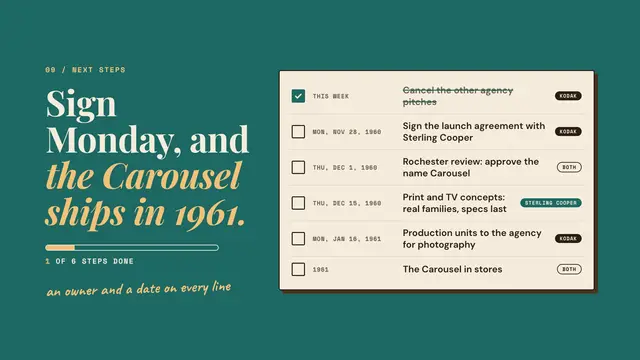
    Mutual action planThe next steps with an owner on each side and a date on every line. Never end on "Thank you".
What good sales do, and where they fail
  • Open on a big shift in the buyer's world, not on your company (Raskin's strategic narrative).
  • On discovery calls, slides cost follow-ups: Gong found reps who used them were 17% less likely to book the next meeting. Ask, then show.
  • Winners spend less time on the deck (9.1 vs 11.4 minutes in intro calls) and 39% less on features (Gong).
  • Use proof from customers like the buyer; generic logos and ROI claims hurt (Gong).
  • End on a mutual action plan with dates and owners on both sides, never "Thank you".
  • Starting with the company history
  • A feature tour
  • Logos from the wrong industry
  • No next step with a date

The deck, slide by slide

Each one opens the live deck at that slide.

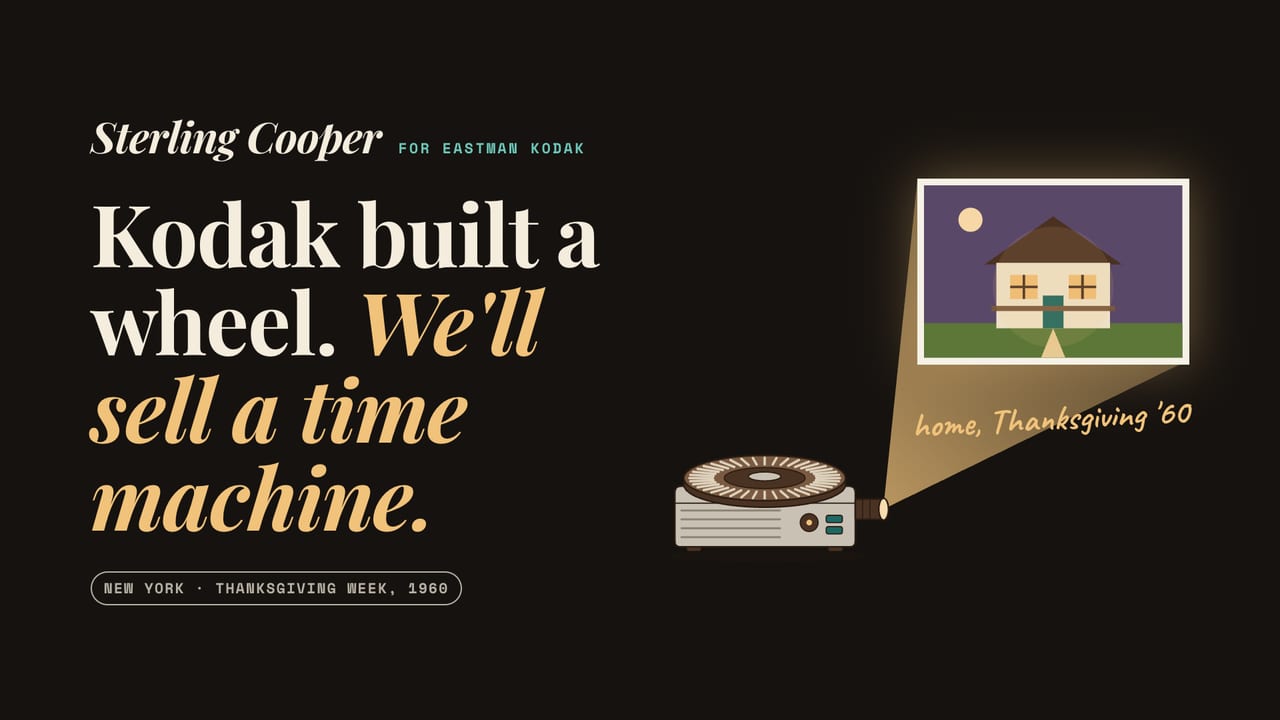
  1. Sterling Cooper deck, slide 1: Kodak built a wheel. We'll sell a time machine. 01Kodak built a wheel. We'll sell a time machine.
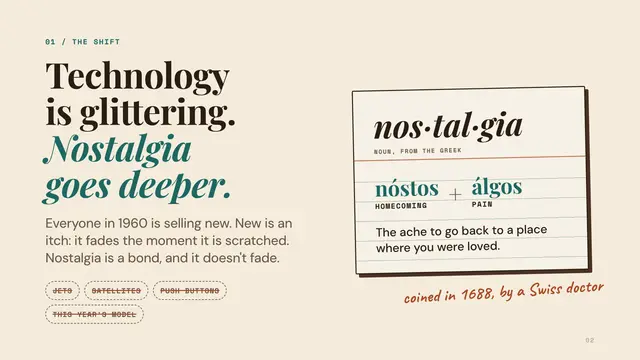
  2. Sterling Cooper deck, slide 2: Technology is glittering. Nostalgia goes deeper. 02Technology is glittering. Nostalgia goes deeper.
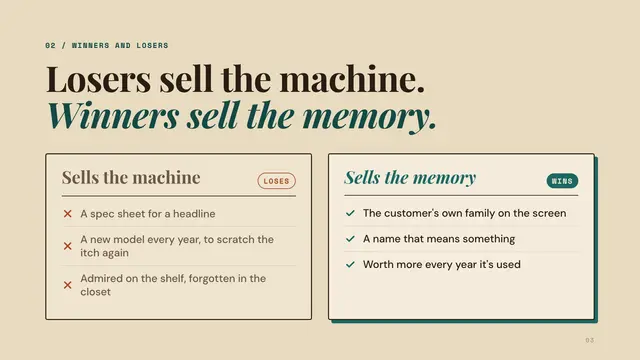
  3. Sterling Cooper deck, slide 3: Losers sell the machine. Winners sell the memory. 03Losers sell the machine. Winners sell the memory.
  4. Sterling Cooper deck, slide 4: Every living room becomes a screening room. 04Every living room becomes a screening room.
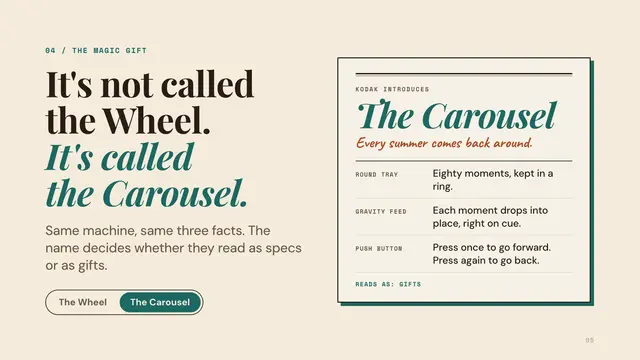
  5. Sterling Cooper deck, slide 5: It's not called the Wheel. It's called the Carousel. 05It's not called the Wheel. It's called the Carousel.
  6. Sterling Cooper deck, slide 6: Press the button and it takes you back. 06Press the button and it takes you back.
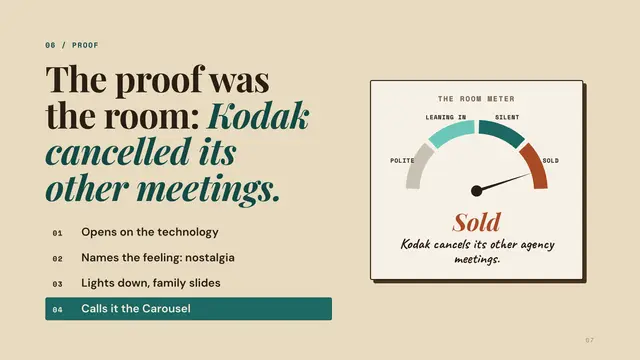
  7. Sterling Cooper deck, slide 7: The proof was the room: Kodak cancelled its other meetings. 07The proof was the room: Kodak cancelled its other meetings.
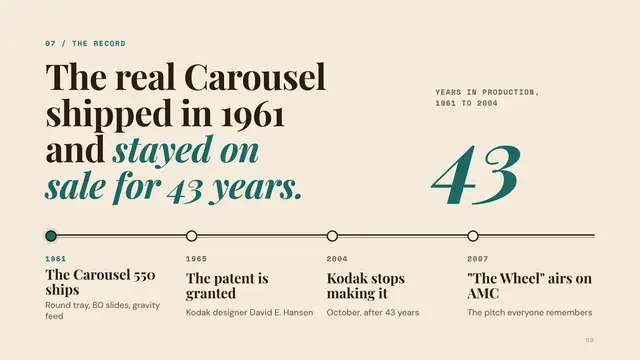
  8. Sterling Cooper deck, slide 8: The real Carousel shipped in 1961 and stayed on sale for 43 years. 08The real Carousel shipped in 1961 and stayed on sale for 43 years.
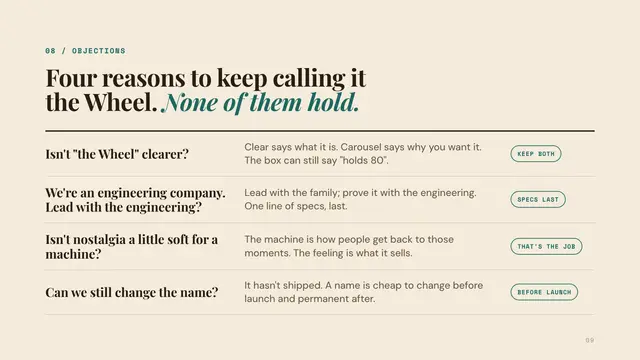
  9. Sterling Cooper deck, slide 9: Four reasons to keep calling it the Wheel. None of them hold. 09Four reasons to keep calling it the Wheel. None of them hold.
  10. Sterling Cooper deck, slide 10: Sign Monday, and the Carousel ships in 1961. 10Sign Monday, and the Carousel ships in 1961.
What really happened, and what the 2026 rebuild changes

What really happened, 1960

  1. Mad Men, season 1 finale, "The Wheel" (AMC, October 2007), set the week of Thanksgiving 1960
  2. Kodak brings Sterling Cooper its new slide projector and its round tray, which it calls the Wheel
  3. Kodak has other agencies lined up to pitch the same job
  4. Don Draper opens on a lesson from an old copywriter: "new" is an itch
  5. He names a deeper bond than new: nostalgia, the ache to go back
  6. Lights down: he runs slides of his own family through the projector
  7. He renames it: not the Wheel, the Carousel
  8. Harry Crane walks out of the room, moved
  9. Kodak cancels its meetings with the other agencies
  10. In real life, Kodak's Carousel 550 went on sale in 1961; Kodak made Carousel projectors until 2004

Read the real story the episode, via Wikipedia

What the rebuild changes

  • Rename the Wheel. One toggle, Wheel or Carousel, rewrites the same three facts in the ad proof from specs into gifts. The machine never changes; the name does all the work.
  • Turn the tray. Eight family slides in a tray you can step through, forward and back, or pick from the ring. A full turn ends at home.
  • The room meter. Walk the pitch step by step and watch the needle move from Polite to Sold, ending where the episode does: Kodak cancels its other meetings.
  • A dated mutual action plan. It ends on six steps with owners on both sides and a date on every line, the first already ticked off. Click to tick the rest. Never "Thank you".

Make yours in ChatGPT

Type your site. We'll write the prompt with Sterling Cooper's structure and your brand.