Leonardo da Vinci's Letter to Ludovico Sforza

Nine war machines. Also, painting. Capabilities deck, c. 1482, rebuilt as a live deck you can play and steal. More in Templates, sales.

Leonardo da Vinci deck, first slide Play the deck
  • 8 slides
  • 10 numbered points
  • 70 tons of bronze
  • Painting: last line

Steal the capabilities deck structure

8 slides, one job each, in this order. Swap in your story and keep the order.

  1. 01
    Who we areName the studio and its promise in one line, with one signature piece of work.
  2. 02
    The client's needShow that every rival offers the same thing, in the client's own terms.
  3. 03
    What we can doNumbered capabilities the client can browse, each with a concrete example.
  4. 04
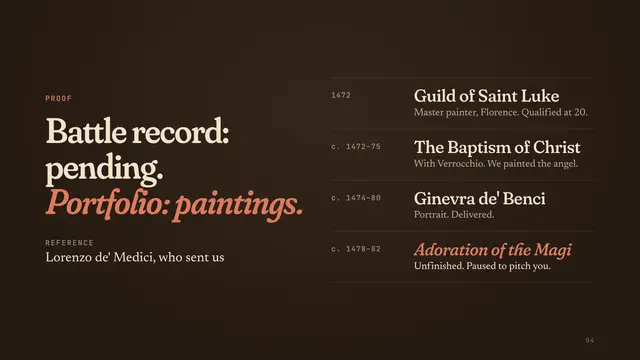
    ProofCredentials, real past work, and one reference, set as a list the client can check.
  5. 05
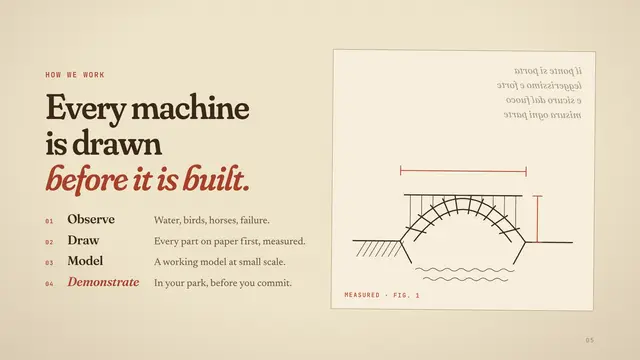
    How we workFour steps from brief to delivery, ending in something the client sees.
  6. 06
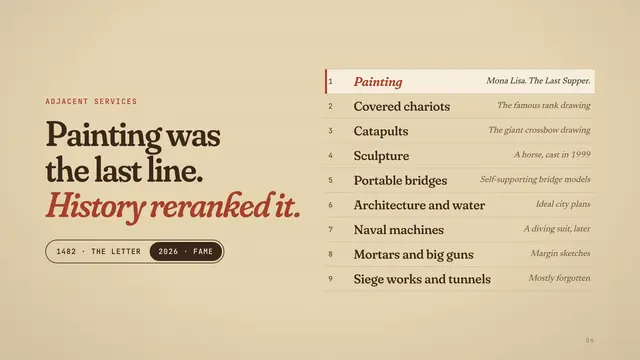
    Adjacent servicesWhat else you do, and how it ranks, so the client can buy more later.
  7. 07
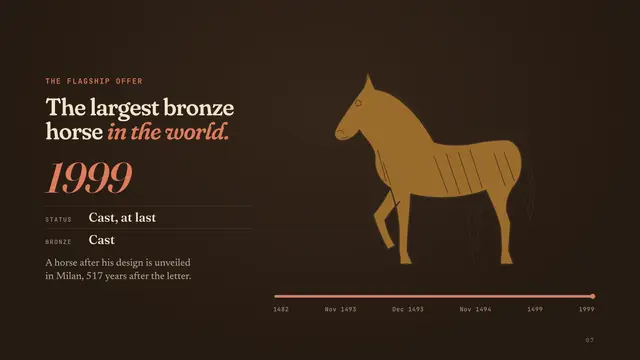
    The flagship offerThe one signature project, with its milestones laid out as a plan.
  8. 08
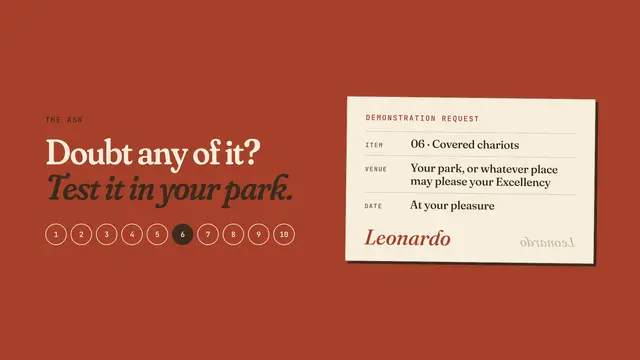
    The askA demonstration on the client's terms: what, where, and when they choose.
What good sales do, and where they fail
  • Open on a big shift in the buyer's world, not on your company (Raskin's strategic narrative).
  • On discovery calls, slides cost follow-ups: Gong found reps who used them were 17% less likely to book the next meeting. Ask, then show.
  • Winners spend less time on the deck (9.1 vs 11.4 minutes in intro calls) and 39% less on features (Gong).
  • Use proof from customers like the buyer; generic logos and ROI claims hurt (Gong).
  • End on a mutual action plan with dates and owners on both sides, never "Thank you".
  • Starting with the company history
  • A feature tour
  • Logos from the wrong industry
  • No next step with a date

The deck, slide by slide

Each one opens the live deck at that slide.

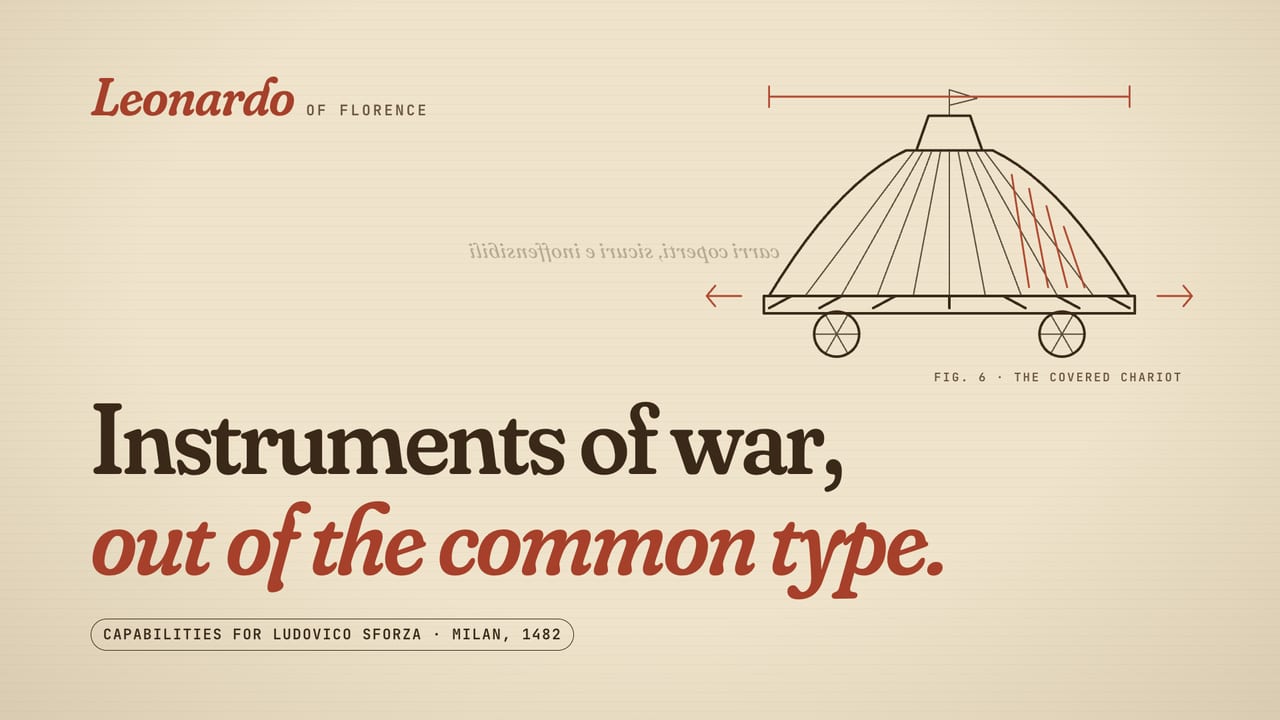
  1. Leonardo da Vinci deck, slide 1: Instruments of war, out of the common type. 01Instruments of war, out of the common type.
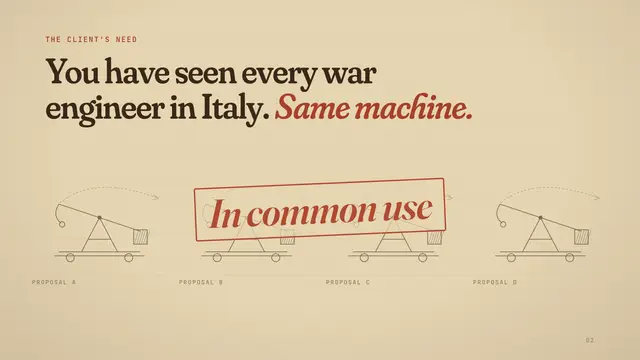
  2. Leonardo da Vinci deck, slide 2: You have seen every war engineer in Italy. Same machine. 02You have seen every war engineer in Italy. Same machine.
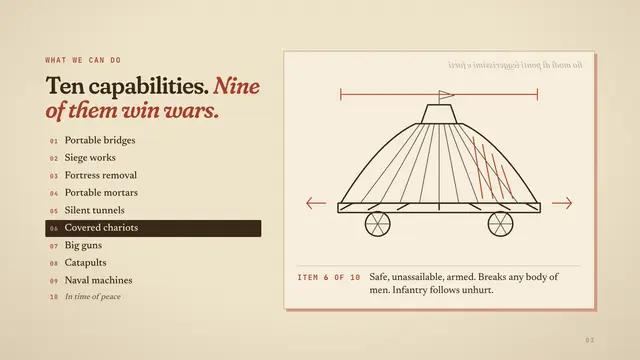
  3. Leonardo da Vinci deck, slide 3: Ten capabilities. Nine of them win wars. 03Ten capabilities. Nine of them win wars.
  4. Leonardo da Vinci deck, slide 4: Battle record: pending. Portfolio: paintings. 04Battle record: pending. Portfolio: paintings.
  5. Leonardo da Vinci deck, slide 5: Every machine is drawn before it is built. 05Every machine is drawn before it is built.
  6. Leonardo da Vinci deck, slide 6: Painting was the last line. History reranked it. 06Painting was the last line. History reranked it.
  7. Leonardo da Vinci deck, slide 7: The largest bronze horse in the world. 07The largest bronze horse in the world.
  8. Leonardo da Vinci deck, slide 8: Doubt any of it? Test it in your park. 08Doubt any of it? Test it in your park.
The original, and what the 2026 rebuild changes

The original, c. 1482, 1 slides

  1. Leonardo, about 30, leaves Florence for Milan in 1482, sent by Lorenzo de' Medici
  2. He drafts a letter to Ludovico Sforza offering his services in ten numbered points
  3. Points one to nine are war machines: bridges, mines, mortars, covered chariots, cannon, catapults, ships
  4. Point ten, for peacetime: architecture, water, sculpture in marble, bronze and clay, and, last of all, painting
  5. He offers to make the great bronze horse for the Sforza monument
  6. And to demonstrate anything in the Duke's park
  7. The surviving draft, in the Codex Atlanticus, is in a copyist's hand
  8. He gets the job: by 1493 the horse stands full size in clay
  9. In 1494 the 70 tons of bronze go to cannon
  10. He paints The Last Supper in Milan, c. 1495 to 1498

See the original c. 1482 deck the Biblioteca Ambrosiana, "Leonardo's Cover Letter" (Codex Atlanticus f. 1082r)

What the rebuild changes

  • The capabilities are an engineering sheet. Click any of the ten items and its mechanism draws itself in sepia ink and red chalk. Item ten is an easel.
  • History reranks the services. Flip from the 1482 order to 2026 fame and watch painting climb from the last line of the letter to the top.
  • The flagship has a project tracker. Drag from the offer to the clay model, the bronze going to cannon, French archers, and the horse finally cast in 1999.
  • The ask is a demo slip. Pick the item you want proved and the request fills in: your park, or wherever your Excellency pleases.

Make yours in ChatGPT

Type your site. We'll write the prompt with Leonardo da Vinci's structure and your brand.