LinkedIn pitch deck

Promised. Delivered. Repeat. Series B pitch deck, 2004, rebuilt as a live deck you can play and steal. More in Templates, pitch decks.

LinkedIn deck, first slide Play the deck
  • 12 slides
  • $10M Series B
  • 38 slides
  • Greylock

Steal the LinkedIn pitch deck structure

12 slides, one job each, in this order. Swap in your story and keep the order.

  1. 01
    CoverThe thesis as one sentence a stranger could repeat.
  2. 02
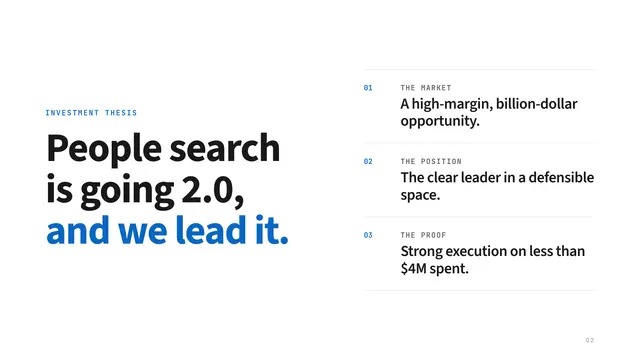
    Investment thesisWhat investors must believe, in three lines.
  3. 03
    Steer into the objectionAnswer the scariest question (no revenue) before the product.
  4. 04
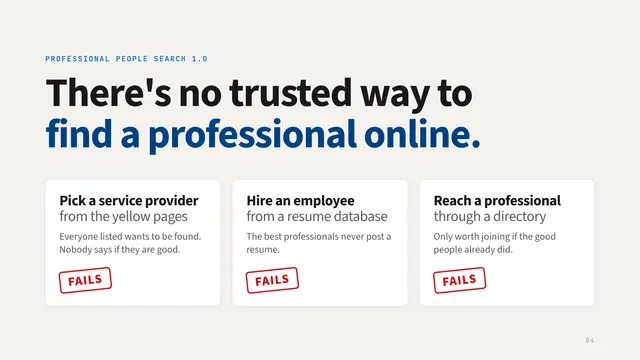
    ProblemName how it is done today and why each way fails.
  5. 05
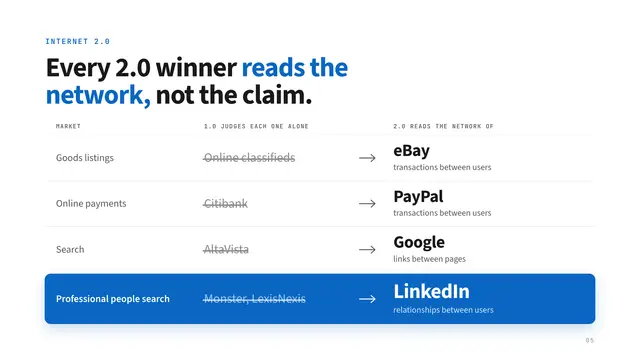
    Pitch by analogyLine up winners investors already understand, ending on you.
  6. 06
    The insightShow the mechanism that makes it big, not a claim.
  7. 07
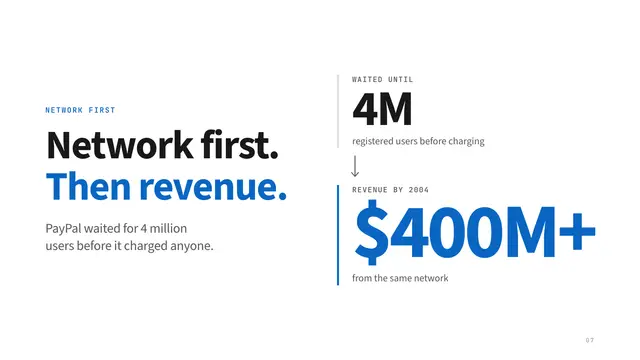
    Why now, why firstOne precedent that proves the order of operations.
  8. 08
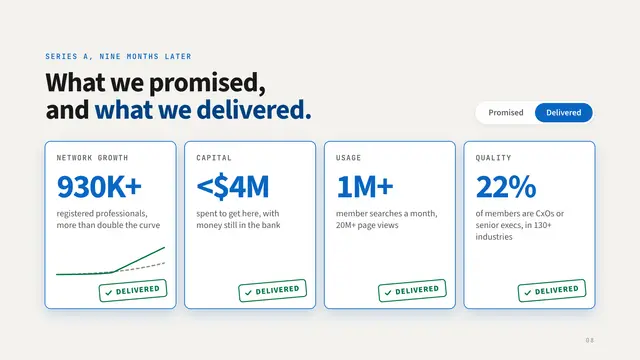
    Promised vs deliveredLast round's promises next to the results.
  9. 09
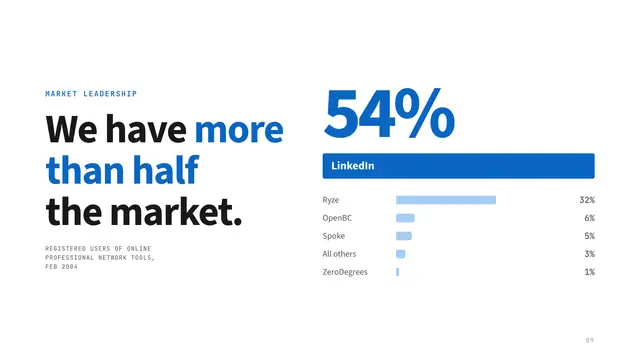
    Market positionYour share of the category, with the field named.
  10. 10
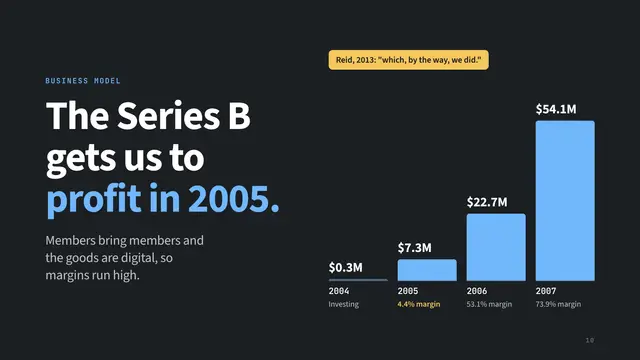
    Path to profitProjections conservative enough to pass the blink test.
  11. 11
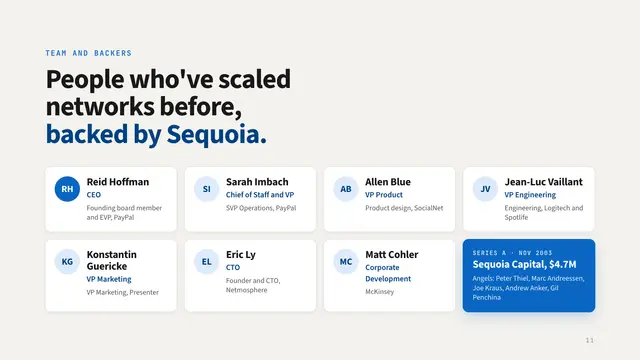
    Team and backersWho executes, and who already bet on them.
  12. 12
    Ask and thesisThe amount, what it unlocks, and the thesis left on screen.
What good pitch decks do, and where they fail
  • Investors skim: DocSend measured about 3.7 minutes per deck, and decks that fail are dropped in about 2. The first two slides decide whether the rest gets read.
  • Every headline is a full-sentence claim, and each beat gets one slide, three at most (Y Combinator).
  • Lead with your strongest proof, traction or team, whichever is stronger.
  • Size the market bottoms-up (customers × price), with the math visible.
  • The ask names an amount, the milestone it buys, and when.
  • Topic-label headlines ("Market", "Team")
  • A top-down TAM with no path to it
  • Traction buried after the product tour
  • An ask with no milestone

Every slide of the LinkedIn pitch deck

Each one opens the live deck at that slide.

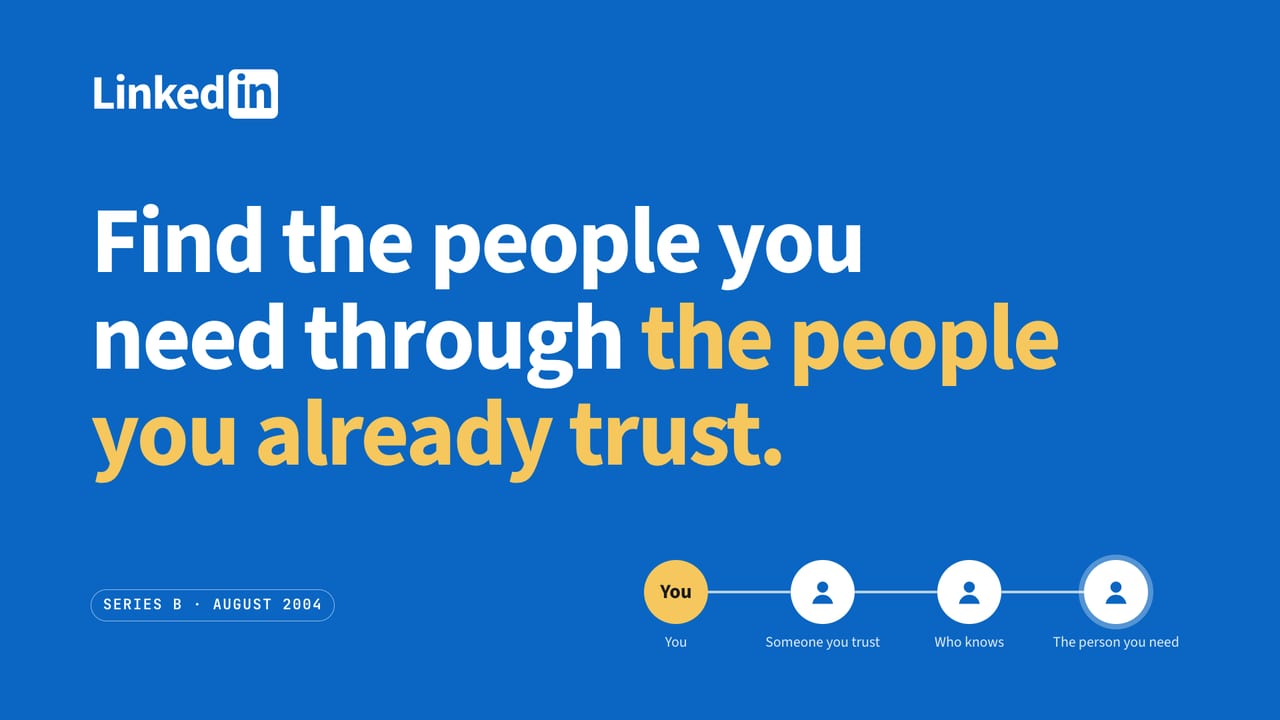
  1. LinkedIn deck, slide 1: Find the people you need through the people you already trust. 01Find the people you need through the people you already trust.
  2. LinkedIn deck, slide 2: People search is going 2.0, and we lead it. 02People search is going 2.0, and we lead it.
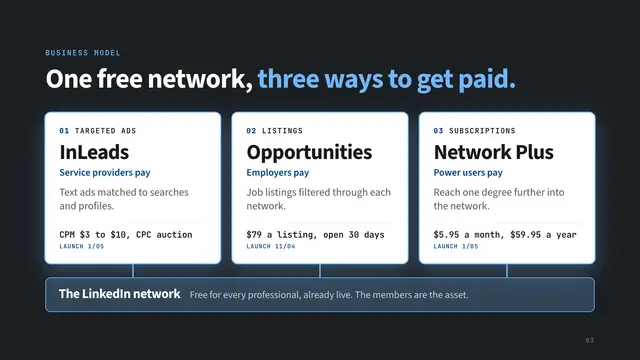
  3. LinkedIn deck, slide 3: One free network, three ways to get paid. 03One free network, three ways to get paid.
  4. LinkedIn deck, slide 4: There's no trusted way to find a professional online. 04There's no trusted way to find a professional online.
  5. LinkedIn deck, slide 5: Every 2.0 winner reads the network, not the claim. 05Every 2.0 winner reads the network, not the claim.
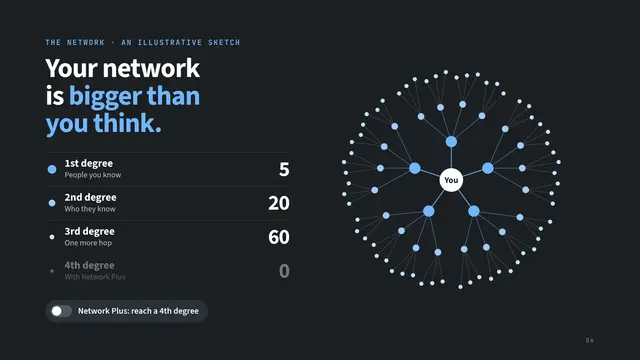
  6. LinkedIn deck, slide 6: Your network is bigger than you think. 06Your network is bigger than you think.
  7. LinkedIn deck, slide 7: Network first. Then revenue. 07Network first. Then revenue.
  8. LinkedIn deck, slide 8: What we promised, and what we delivered. 08What we promised, and what we delivered.
  9. LinkedIn deck, slide 9: We have more than half the market. 09We have more than half the market.
  10. LinkedIn deck, slide 10: The Series B gets us to profit in 2005. 10The Series B gets us to profit in 2005.
  11. LinkedIn deck, slide 11: People who've scaled networks before, backed by Sequoia. 11People who've scaled networks before, backed by Sequoia.
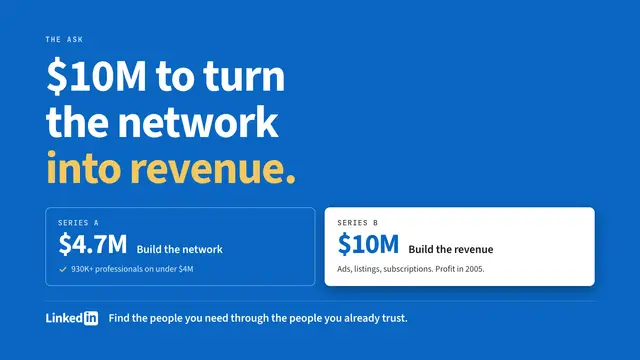
  12. LinkedIn deck, slide 12: $10M to turn the network into revenue. 12$10M to turn the network into revenue.
The original, and what the 2026 rebuild changes

The original, 2004, 38 slides

  1. Cover: "Find and contact the people you need through the people you already trust"
  2. Professional people search 2.0: ads, listings, subscriptions
  3. Problem: yellow pages, resume databases, directories all fail
  4. Internet 2.0: from directories to networks
  5. Analogies: eBay, PayPal, Google, then LinkedIn vs Monster
  6. Network first: PayPal waited for 4M users, now $400MM+
  7. Series A growth commitment vs actual growth
  8. Market leadership: 54% of professional network users
  9. Competition, barriers to entry, partners
  10. Strong results with less than $4M spent
  11. Network enables revenue, market sizes, product mockups
  12. Revenue is near-term: pricing and launch dates
  13. High margins, assumptions, profitable in 2005
  14. Team, board and investors
  15. Thesis wrap-up, then the cover again

See the original 2004 deck Reid Hoffman, annotated

What the rebuild changes

  • Promised flips to delivered. Four Series A promises sit on cards that turn over to the result with a stamp: about 400K members promised, 930K+ delivered.
  • The tagline becomes a graph. "Your network is bigger than you think" grows ring by ring, counting each degree, and a toggle adds Network Plus's fourth.
  • Three revenue streams light up. Ads, listings, and subscriptions light one by one over the free network. Tap one to isolate its price and launch date.
  • Thesis first, thesis last. Reid's own advice, applied: the thesis moves from slide 36 to slide 2, and the close merges the ask with the cover line.

Make yours in ChatGPT

Type your site. We'll write the prompt with LinkedIn's structure and your brand.