It's a live deck. Press start, then scroll or use the arrow keys, or play it full screen.
Play the 2026 deckApollo 13's post-mortem, slide by slide
-
 01Houston, we've had a post-mortem.
 -
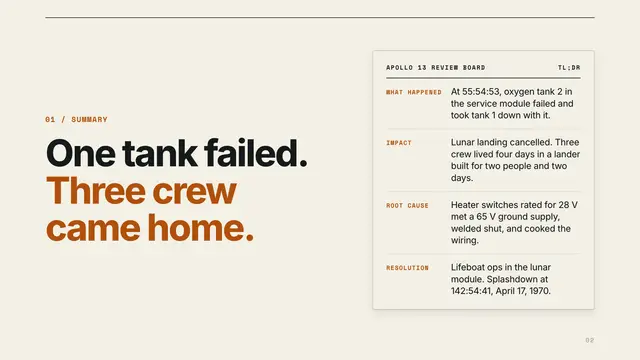 02One tank failed. Three crew came home.
 -
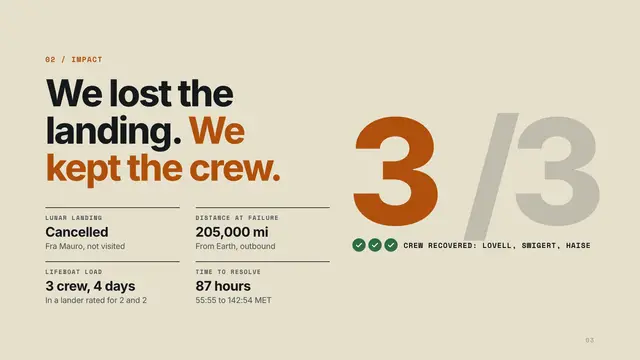 03We lost the landing. We kept the crew.
 -
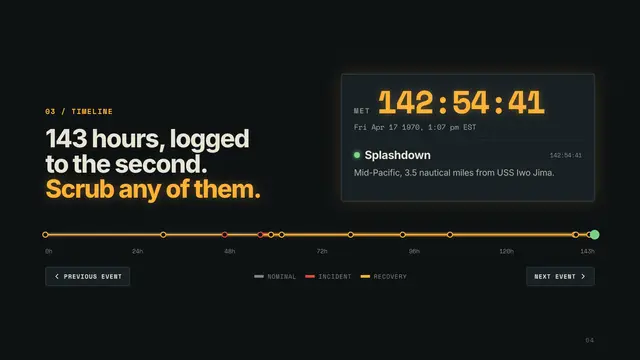 04143 hours, logged to the second. Scrub any of them.
 -
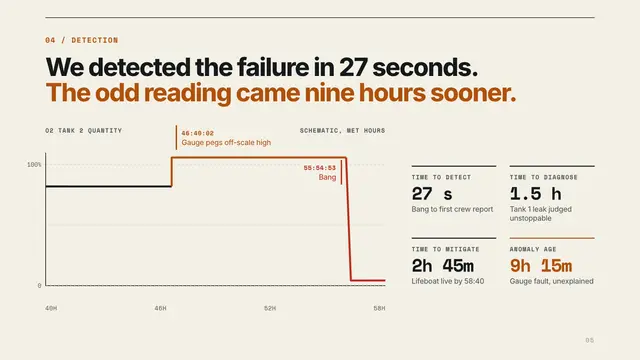 05We detected the failure in 27 seconds. The odd reading came nine hours sooner.
 -
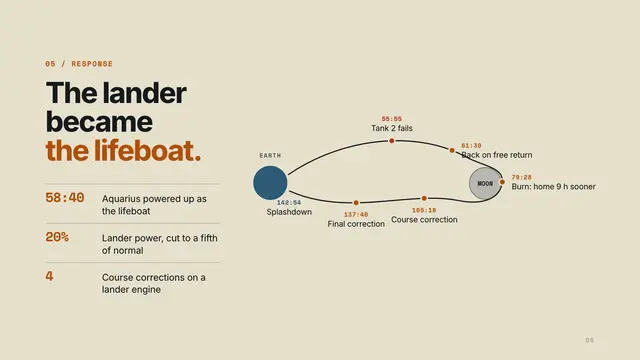 06The lander became the lifeboat.
 -
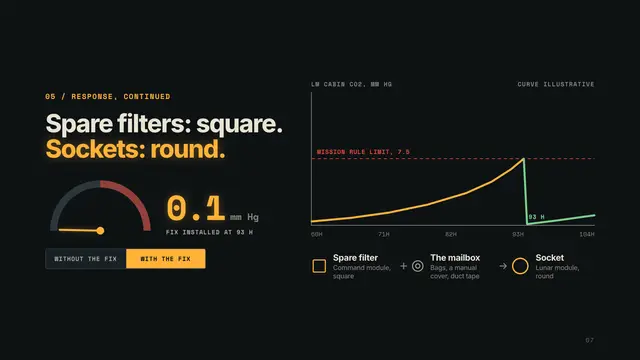 07Spare filters: square. Sockets: round.
 -
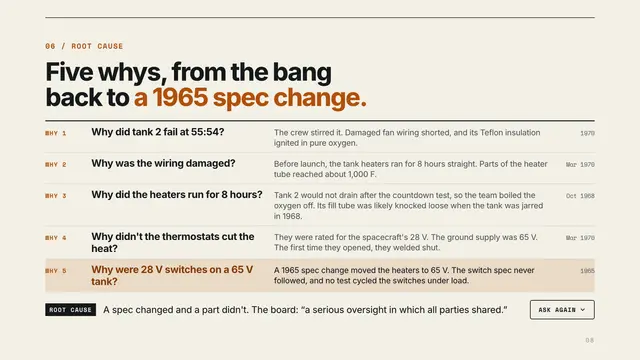 08Five whys, from the bang back to a 1965 spec change.
 -
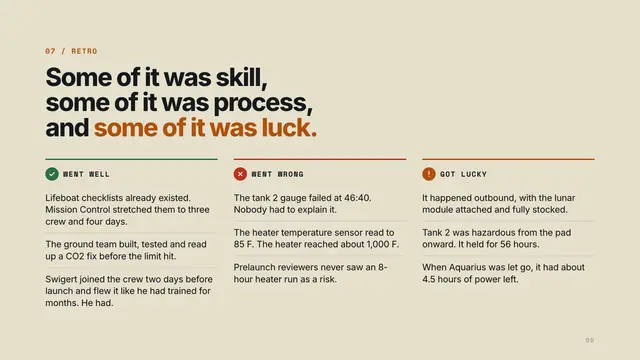 09Some of it was skill, some of it was process, and some of it was luck.
 -
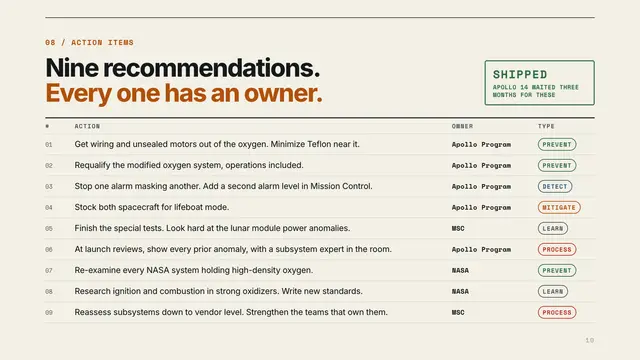 10Nine recommendations. Every one has an owner.
 -
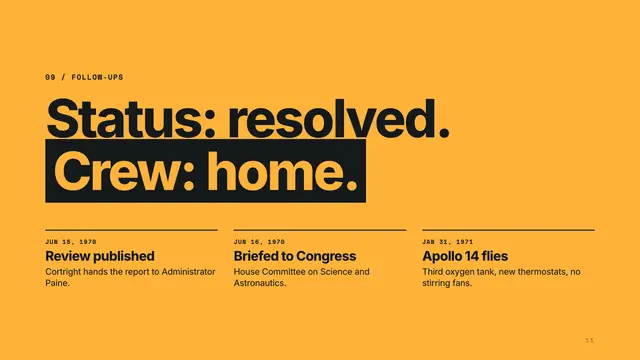 11Status: resolved. Crew: home.
Then · 1970
How it really went
Read the real storythe Apollo 13 Review Board report (Cortright, June 1970), via NASA History ↗- April 11, 1970: Apollo 13 launches for Fra Mauro
- 46:40: the tank 2 quantity gauge fails off-scale high
- 55:54:53: oxygen tank 2 fails; "Houston, we've had a problem"
- The lunar module Aquarius becomes a lifeboat
- A free-return burn swings them around the Moon
- At 93 hours, square CO2 cartridges go into round sockets
- April 17: splashdown in the Pacific, all three crew safe
- April 17: NASA convenes a review board under Edgar Cortright
- June 15: the report finds 28 V switches on a 65 V ground supply
- Nine recommendations; Apollo 14 slips to January 1971 to ship them
Now · 2026 · 11 slides
What we changed
- Scrub the whole mission143 hours on one scrubber: drag from liftoff to splashdown and watch fourteen logged events light up, with the MET and the 1970 wall clock ticking alongside.
- Five whys, one at a timeThe board's findings become a five-whys chain that reveals cause by cause, from the bang at 55:54 back to a 1965 spec change nobody carried through.
- The square peg, liveA CO2 gauge climbs toward the 7.5 mm Hg limit until the mailbox goes in. Flip the fix off and watch the needle run into the red.
- Where we got luckyThe column most post-mortems skip: the lifeboat was still attached, the bad tank held for 56 hours, and Aquarius had 4.5 hours of power to spare.
Steal the structure
Build your post-mortem like Apollo 13 did.
- 01 Cover Incident name, detection time, severity, status, and the words "blameless review".
- 02 Summary What happened, impact, root cause, resolution: four lines an executive can read in thirty seconds.
- 03 Impact Lead with the outcome that matters most, then what it cost, in one hero number and a quiet row.
- 04 Timeline Every event with a timestamp, scrubbable, color-coded by phase.
- 05 Detection Time to detect, diagnose and mitigate, plus every earlier signal you missed.
- 06 Response What the team did to stop the bleeding, in the order it happened.
- 07 Key mitigation The one fix that saved you, shown working against its limit.
- 08 Root cause Five whys, from the symptom to the decision that made it possible.
- 09 Retro What went well, what went wrong, and where you got lucky, three items each.
- 10 Action items Every fix with one owner and a type: prevent, detect, mitigate, process, learn.
- 11 Follow-ups Status, then dated follow-ups, so the review ends on what happens next.
Make yours in ChatGPT
Type your site. We'll write the prompt with Apollo 13's structure and your brand.