It's a live deck. Press start, then scroll or use the arrow keys, or play it full screen.
Play the 2026 deckCharles Darwin's big decision deck, slide by slide
-
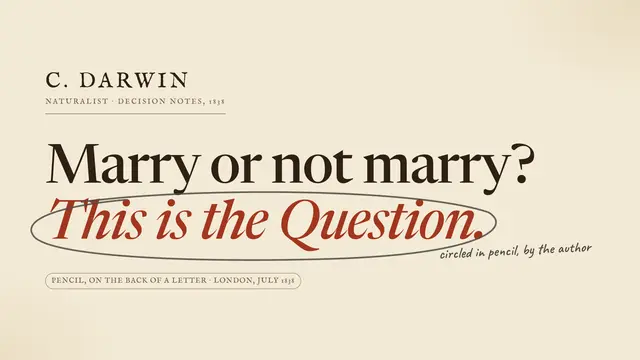 01Marry or not marry? This is the Question.
 -
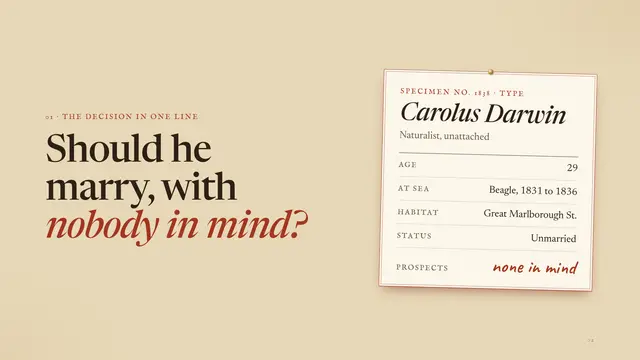 02Should he marry, with nobody in mind?
 -
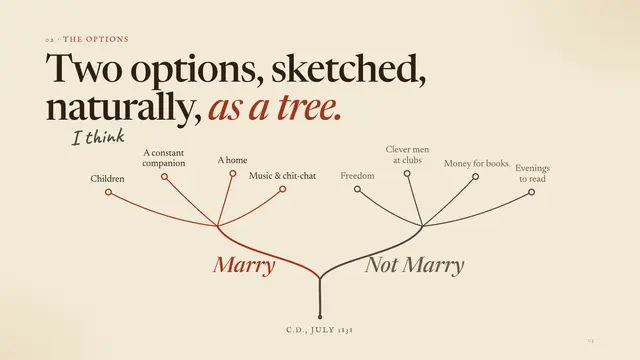 03Two options, sketched, naturally, as a tree.
 -
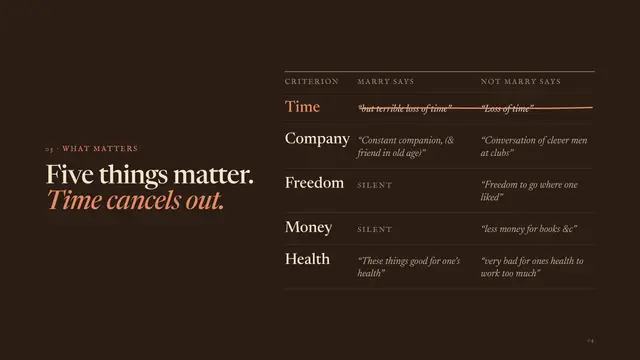 04Five things matter. Time cancels out.
 -
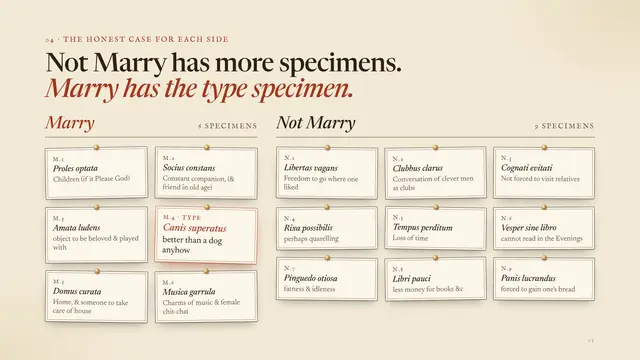 05Not Marry has more specimens. Marry has the type specimen.
 -
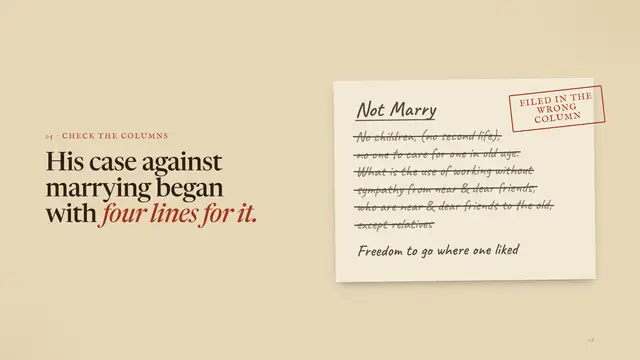 06His case against marrying began with four lines for it.
 -
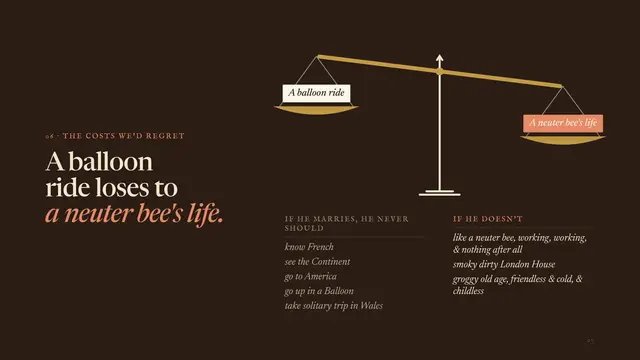 07A balloon ride loses to a neuter bee's life.
 -
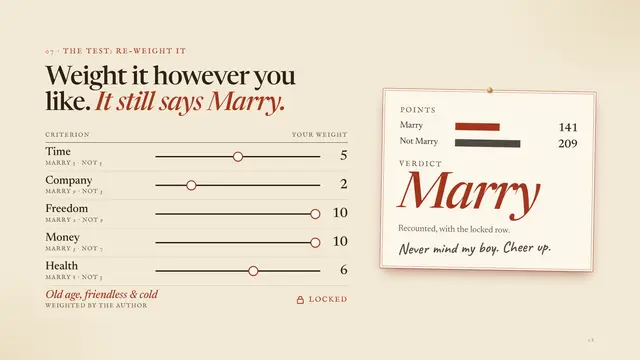 08Weight it however you like. It still says Marry.
 -
![Charles Darwin deck, slide 9: Marry, Mary,[sic] Marry. Q.E.D.](/art/arcade/darwin-marry/09.webp) 09Marry, Mary,[sic] Marry. Q.E.D.
09Marry, Mary,[sic] Marry. Q.E.D. -
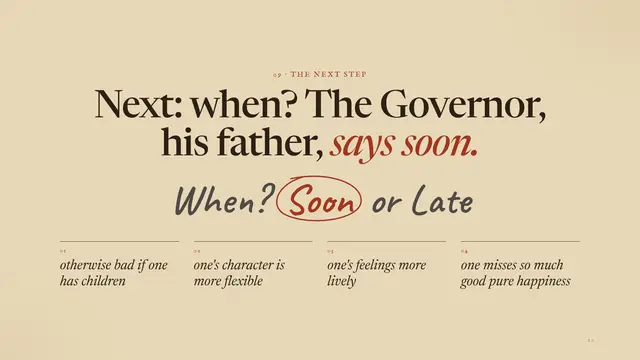 10Next: when? The Governor, his father, says soon.
 -
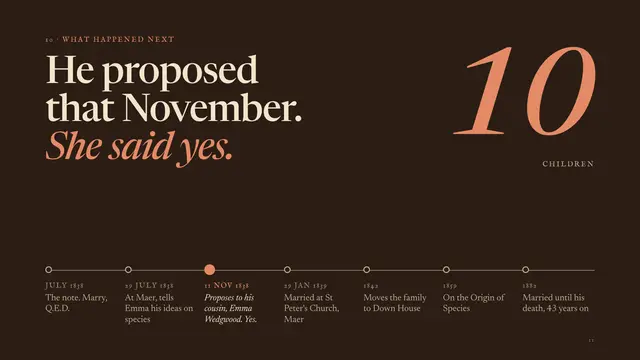 11He proposed that November. She said yes.
Then · 1838 · 1 slides
The original
See the original 1838 deckDarwin Correspondence Project, Cambridge (transcription of DAR 210.8:2) ↗- July 1838: Darwin, 29, writes "This is the Question" in pencil and circles it
- Two columns: "Marry" and "Not Marry"
- Marry: children, a constant companion, "better than a dog anyhow"
- Not Marry opens with four lines for marrying; he strikes them out
- Not Marry, take two: freedom, clever men at clubs, money for books
- The verdict: "Marry, Mary, Marry Q.E.D."
- Overleaf, "When? Soon or Late": his father, "the Governor", says soon
- He proposes to his cousin Emma Wedgwood on 11 November 1838; she says yes
- They marry on 29 January 1839 and have ten children
Now · 2026 · 11 slides
What we changed
- The columns become a specimen drawerEvery pro and con is pinned on its own museum label with a Latin name. "Better than a dog anyhow" gets the red border of the type specimen.
- A scorecard you can rig, and loseDrag the weights toward Not Marry until it wins on points. The verdict stays Marry: the last row is locked by the author, and a pencil note says "Never mind my boy. Cheer up."
- The regrets go on a scaleA balloon ride and a trip to Wales on one pan, a neuter bee's life on the other. It tips the way his sentences do.
- The bias check is on the pageThe four lines he struck from the top of Not Marry, crossed out again in pencil and stamped "Filed in the wrong column".
Steal the structure
Build your big decision deck like Charles Darwin did.
- 01 The question Name the decision in one line, in the words you would actually say.
- 02 The facts Where things stand today, on one card, before anyone argues.
- 03 The options Draw each option as a path with what it leads to, not as a label.
- 04 What matters Pick the criteria first and note any that appear on both sides, so they cancel out.
- 05 The case for each side Every pro and con in plain words, with the strongest one marked.
- 06 Bias check Read each column for arguments filed on the wrong side, and move them.
- 07 The regrets What you would miss under each option, weighed side by side.
- 08 The test A weighted scorecard anyone can re-weight, showing which row really decides.
- 09 The call The decision, stated once, in words nobody can misread.
- 10 The next step When it happens, who you asked, and their reasons.
- 11 What happened next Close the loop with dates, so the next big decision learns from this one.
Make yours in ChatGPT
Type your site. We'll write the prompt with Charles Darwin's structure and your brand.