Dunder Mifflin from The Office

Ten clients walked out with their salesman. Then they walked back in. Company overview deck, 2005, rebuilt as a live deck you can play and steal. More in Templates, sales.

Dunder Mifflin deck, first slide Play the deck
  • 10 slides
  • 9 seasons, 2005 to 2013
  • 10 clients followed Michael
  • 1 branch kept through every cut

Steal the company overview deck structure

10 slides, one job each, in this order. Swap in your story and keep the order.

  1. 01
    CoverWho you are and the one thing you do better than anyone, in a sentence.
  2. 02
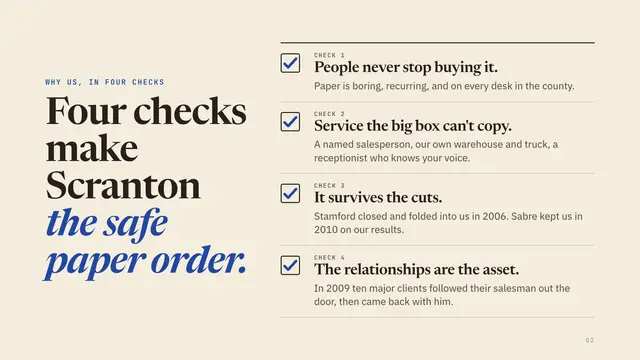
    Why us, in four checksThe investment-style thesis: four claims a buyer can repeat to their boss, each with its evidence.
  3. 03
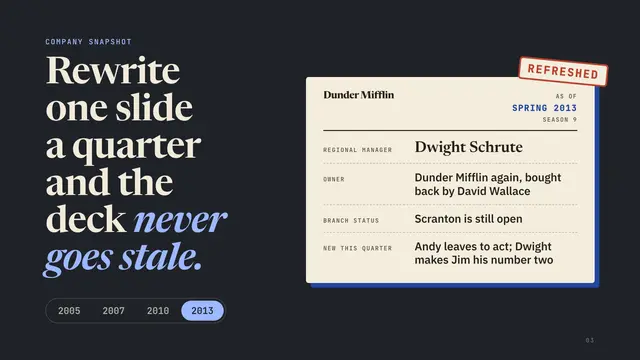
    Company snapshotThe facts that change: leaders, ownership, footprint, what is new. The slide you rewrite every quarter.
  4. 04
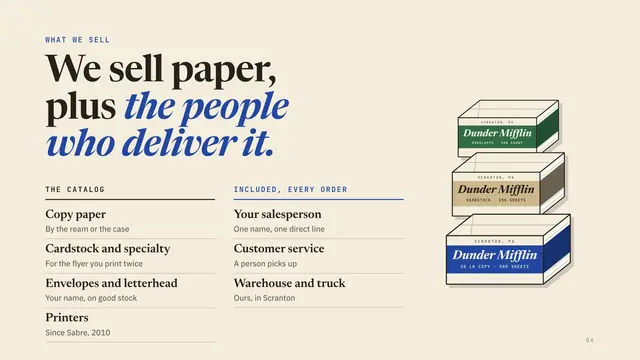
    What we sellThe products in a breath, then what comes with every order.
  5. 05
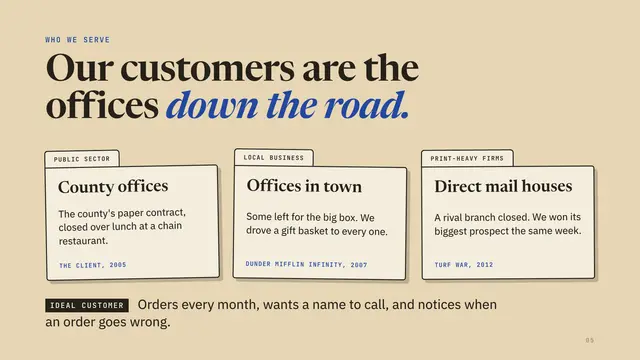
    Who we serveThe customer segments, each with a real account story, and the ideal customer in one line.
  6. 06
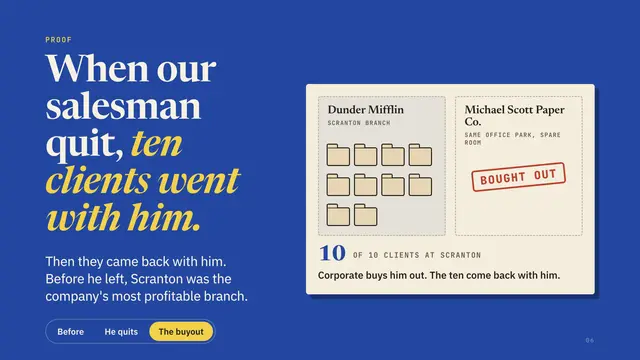
    ProofResults and customers. The strongest proof is a customer choosing you twice.
  7. 07
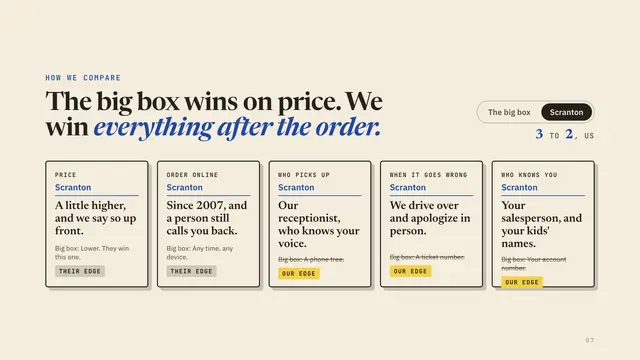
    How we compareAn honest comparison with the main alternative that concedes where they win.
  8. 08
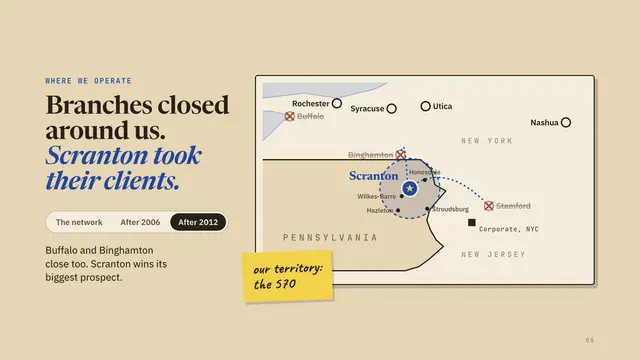
    Where we operateYour territory and footprint on a map, and how it has changed.
  9. 09
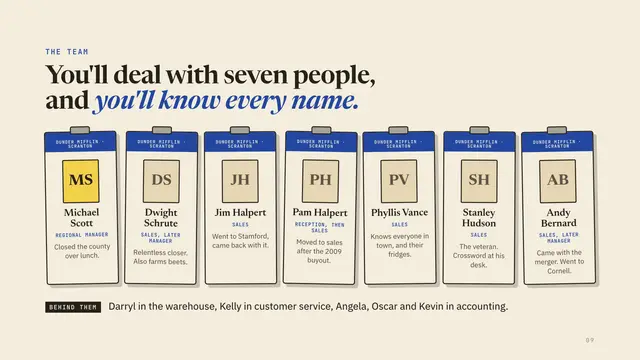
    The teamThe names and roles the buyer will actually deal with.
  10. 10
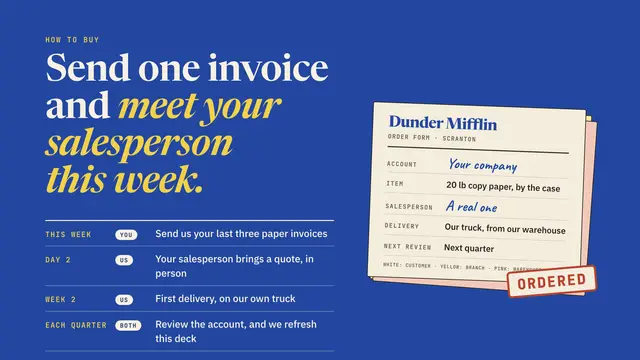
    How to buyThe next step with dates and owners on both sides, and when the deck gets refreshed.
What good sales do, and where they fail
  • Open on a big shift in the buyer's world, not on your company (Raskin's strategic narrative).
  • On discovery calls, slides cost follow-ups: Gong found reps who used them were 17% less likely to book the next meeting. Ask, then show.
  • Winners spend less time on the deck (9.1 vs 11.4 minutes in intro calls) and 39% less on features (Gong).
  • Use proof from customers like the buyer; generic logos and ROI claims hurt (Gong).
  • End on a mutual action plan with dates and owners on both sides, never "Thank you".
  • Starting with the company history
  • A feature tour
  • Logos from the wrong industry
  • No next step with a date

The deck, slide by slide

Each one opens the live deck at that slide.

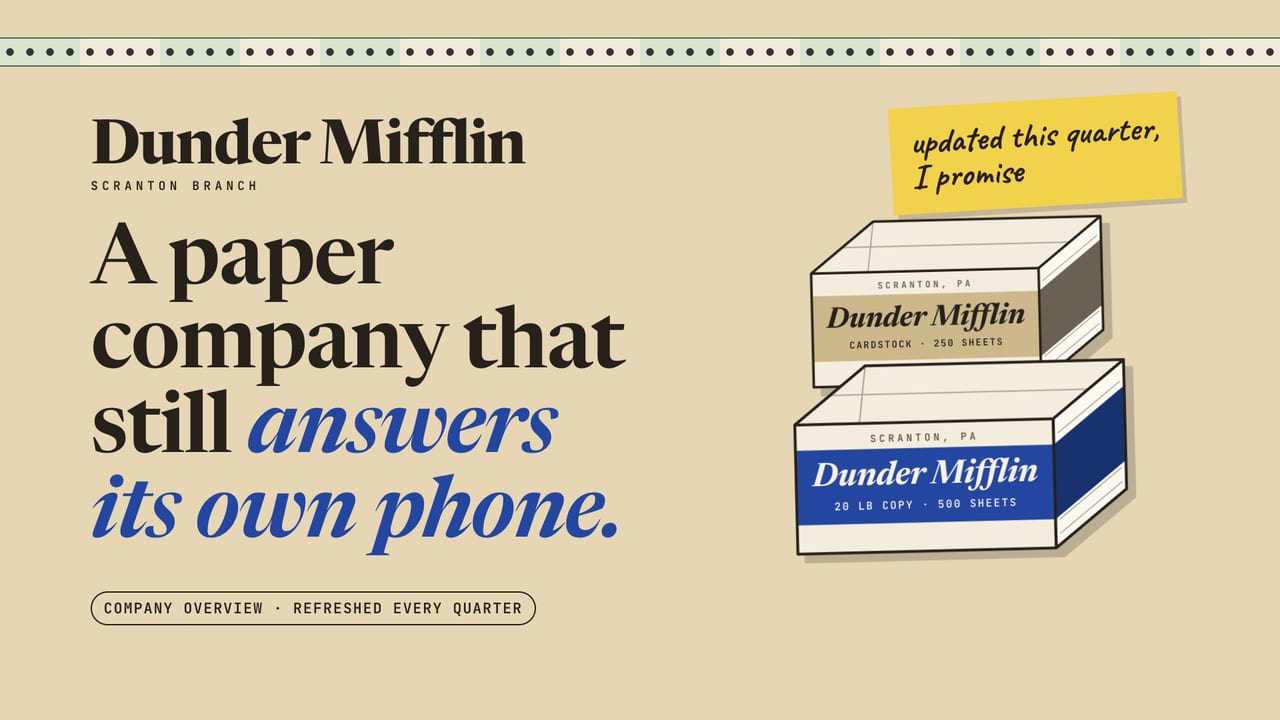
  1. Dunder Mifflin deck, slide 1: A paper company that still answers its own phone. 01A paper company that still answers its own phone.
  2. Dunder Mifflin deck, slide 2: Four checks make Scranton the safe paper order. 02Four checks make Scranton the safe paper order.
  3. Dunder Mifflin deck, slide 3: Rewrite one slide a quarter and the deck never goes stale. 03Rewrite one slide a quarter and the deck never goes stale.
  4. Dunder Mifflin deck, slide 4: We sell paper, plus the people who deliver it. 04We sell paper, plus the people who deliver it.
  5. Dunder Mifflin deck, slide 5: Our customers are the offices down the road. 05Our customers are the offices down the road.
  6. Dunder Mifflin deck, slide 6: When our salesman quit, ten clients went with him. 06When our salesman quit, ten clients went with him.
  7. Dunder Mifflin deck, slide 7: The big box wins on price. We win everything after the order. 07The big box wins on price. We win everything after the order.
  8. Dunder Mifflin deck, slide 8: Branches closed around us. Scranton took their clients. 08Branches closed around us. Scranton took their clients.
  9. Dunder Mifflin deck, slide 9: You'll deal with seven people, and you'll know every name. 09You'll deal with seven people, and you'll know every name.
  10. Dunder Mifflin deck, slide 10: Send one invoice and meet your salesperson this week. 10Send one invoice and meet your salesperson this week.
What really happened, and what the 2026 rebuild changes

What really happened, 2005

  1. March 2005: a documentary crew moves into a regional paper company in Scranton, PA
  2. Big box chains undercut it on price all series long
  3. November 2005: Michael closes a county contract over lunch at Chili's ("The Client")
  4. November 2006: corporate plans to close Scranton, then closes Stamford and merges it in
  5. 2007: lost clients ask for online ordering; the Dunder Mifflin Infinity website launches
  6. Spring 2009: Michael quits, starts the Michael Scott Paper Company, and takes ten major clients
  7. April 2009: corporate buys him out; he returns with Pam and Ryan as salespeople
  8. 2010: the printer company Sabre buys the bankrupt Dunder Mifflin; Scranton survives
  9. 2012: Binghamton closes and Scranton fights Syracuse for its clients; David Wallace buys the company back
  10. May 2013: Dwight is regional manager and the branch is still open

Read the real story the show, via Wikipedia

What the rebuild changes

  • Refresh the snapshot. Press 2005, 2007, 2010 or 2013 and the one slide you rewrite every quarter updates: manager, owner, branch status, what changed. It plays through all four on entry.
  • Watch the clients leave and come back. Ten client folders slide from the Scranton branch to the Michael Scott Paper Company and back again after the buyout. Proof that the relationships are the asset.
  • Flip personal service against the big box. Five cards, five questions. The big box wins on price and online ordering, and the deck says so; flip them and Scranton wins the other three.
  • Redraw the branch map. A Northeast map with the 570 territory around Scranton. Step through the closures and watch Stamford, Buffalo and Binghamton go dark while their clients flow to Scranton.

Make yours in ChatGPT

Type your site. We'll write the prompt with Dunder Mifflin's structure and your brand.