Taylor's Version: Taylor Swift's Masters as a Make-vs-Buy Business Case

Can't buy it? Make it again. Make-vs-buy business case, 2019 to 2025, rebuilt as a live deck you can play and steal. More in Templates, proposals and business cases.

Taylor's Version deck, first slide Play the deck
  • 12 slides
  • 6 albums
  • 4 re-recorded
  • Bought back May 2025

Steal the make-vs-buy business case structure

11 slides, one job each, in this order. Swap in your story and keep the order.

  1. 01
    The decisionOne sentence: buy this, or build our own. What you are asking them to approve.
  2. 02
    Why nowThe dated events that forced the decision, and the window that just opened.
  3. 03
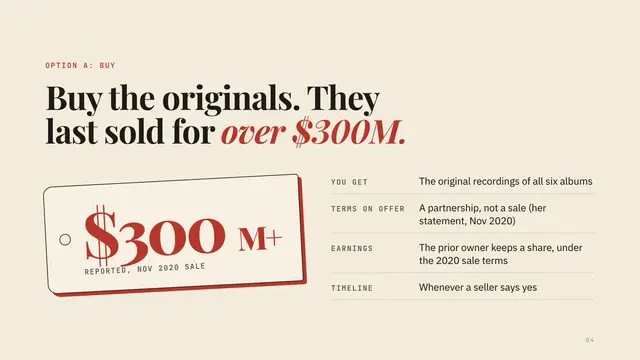
    Option A: buyWhat you get, the price with its source, the terms on offer, and the timeline.
  4. 04
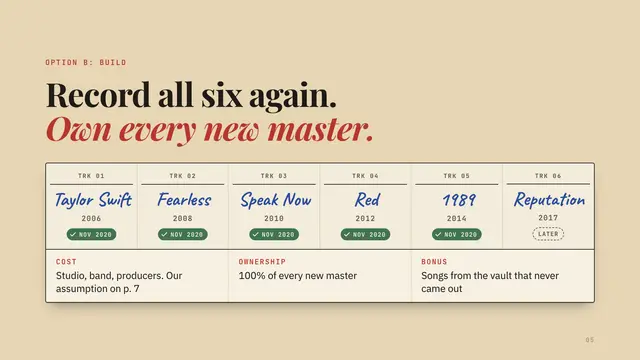
    Option B: buildWhat you would make, what you would own, the cost basis, and the bonus only building gives you.
  5. 05
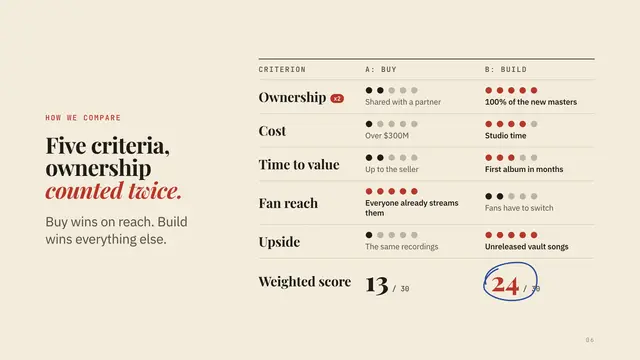
    How we compareWeighted criteria agreed up front, scored side by side, including the row the other option wins.
  6. 06
    The mathA calculator with sourced figures and labeled assumptions, so the room can test the break-even.
  7. 07
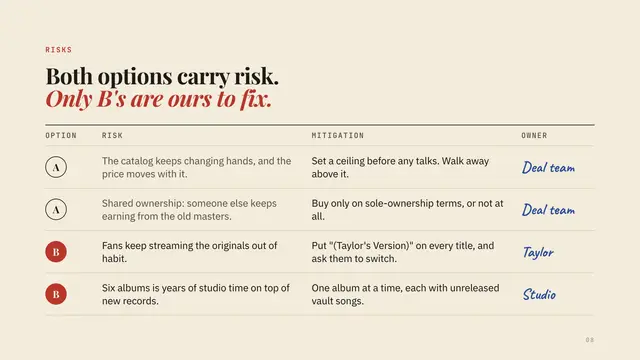
    RisksA register for both options, each risk with a mitigation and an owner.
  8. 08
    Early proofThe pilot result, against the benchmark you set.
  9. 09
    AdoptionWhether users actually switched, shown as a share, with the exception called out.
  10. 10
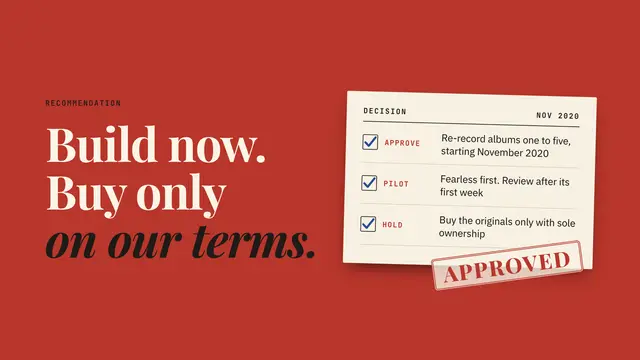
    RecommendationThe call, then the line items to approve and when you review it.
  11. 11
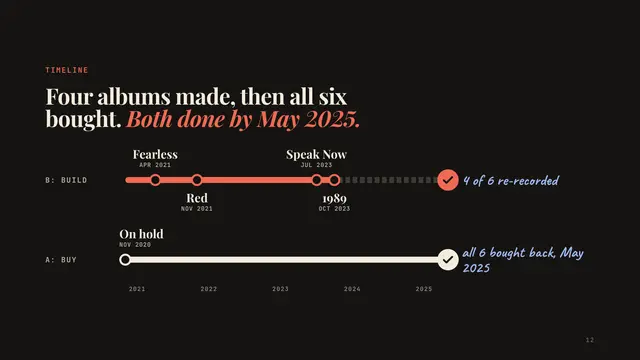
    TimelineBoth tracks on one timeline, with the milestone that closes each.
What good proposals and business cases do, and where they fail
  • Start with their goal in their words, not your company.
  • Check off every requirement in the brief, visibly.
  • Put the decision on the first slide: what you are asking them to approve.
  • Show the options you considered and why this one wins.
  • Cost, phasing, and terms in one place; risks each with an owner; next steps with a date.
  • A credentials deck instead of an answer
  • Missing a requirement from the brief
  • Price hidden or vague
  • No decision asked for

The deck, slide by slide

Each one opens the live deck at that slide.

  1. Taylor's Version deck, slide 1: Six albums. Two ways to own them. 01Six albums. Two ways to own them.
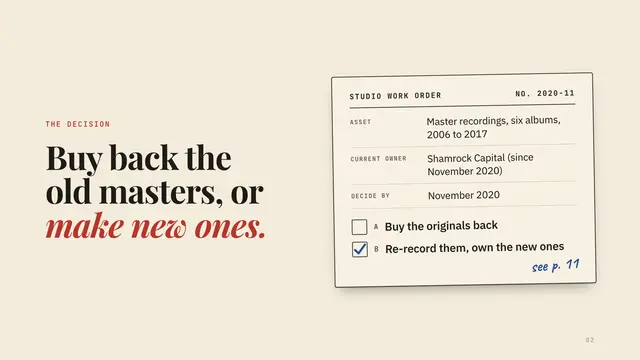
  2. Taylor's Version deck, slide 2: Buy back the old masters, or make new ones. 02Buy back the old masters, or make new ones.
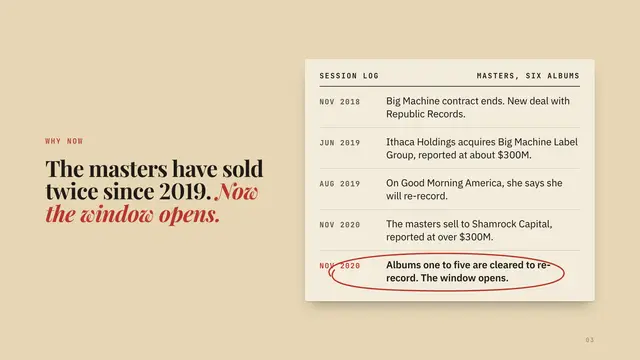
  3. Taylor's Version deck, slide 3: The masters have sold twice since 2019. Now the window opens. 03The masters have sold twice since 2019. Now the window opens.
  4. Taylor's Version deck, slide 4: Buy the originals. They last sold for over $300M. 04Buy the originals. They last sold for over $300M.
  5. Taylor's Version deck, slide 5: Record all six again. Own every new master. 05Record all six again. Own every new master.
  6. Taylor's Version deck, slide 6: Five criteria, ownership counted twice. 06Five criteria, ownership counted twice.
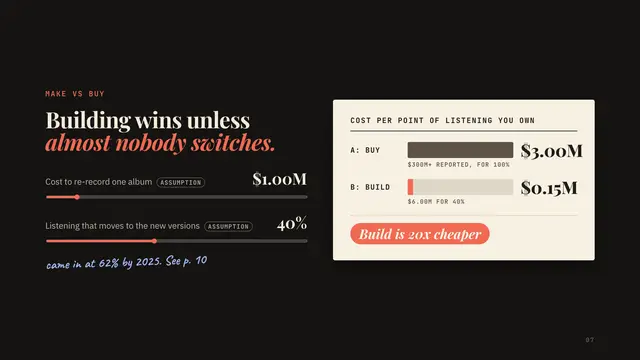
  7. Taylor's Version deck, slide 7: Building wins unless almost nobody switches. 07Building wins unless almost nobody switches.
  8. Taylor's Version deck, slide 8: Both options carry risk. Only B's are ours to fix. 08Both options carry risk. Only B's are ours to fix.
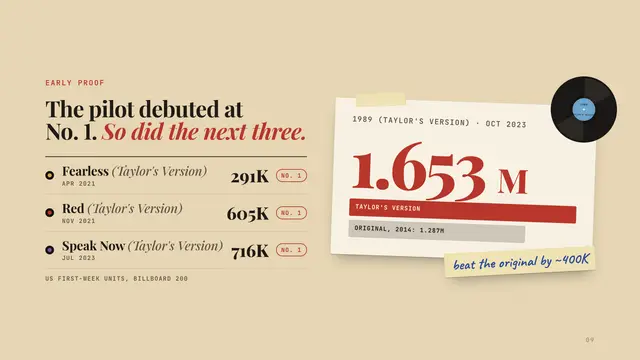
  9. Taylor's Version deck, slide 9: The pilot debuted at No. 1. So did the next three. 09The pilot debuted at No. 1. So did the next three.
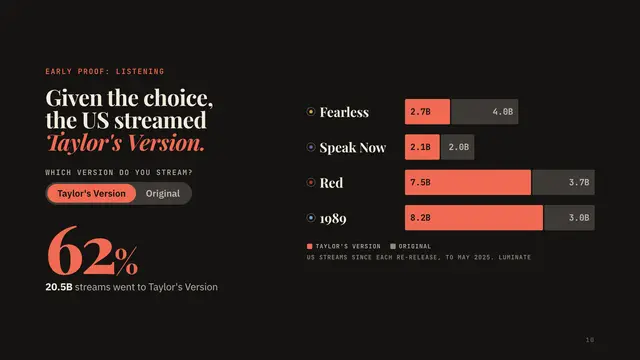
  10. Taylor's Version deck, slide 10: Given the choice, the US streamed Taylor's Version. 10Given the choice, the US streamed Taylor's Version.
  11. Taylor's Version deck, slide 11: Build now. Buy only on our terms. 11Build now. Buy only on our terms.
  12. Taylor's Version deck, slide 12: Four albums made, then all six bought. Both done by May 2025. 12Four albums made, then all six bought. Both done by May 2025.
What really happened, and what the 2026 rebuild changes

What really happened, 2019 to 2025

  1. 2005: she signs with Big Machine Records; the label owns the masters of her first six albums
  2. November 2018: the contract ends and she signs with Republic Records
  3. June 2019: Ithaca Holdings acquires Big Machine Label Group, reported at about $300M
  4. August 2019: she says she will re-record albums one to five from November 2020
  5. November 2020: the masters are sold to Shamrock Capital, reported at over $300M; she begins re-recording
  6. April 2021: Fearless (Taylor's Version) debuts at No. 1
  7. November 2021: Red (Taylor's Version) debuts at No. 1
  8. July 2023: Speak Now (Taylor's Version) debuts at No. 1
  9. October 2023: 1989 (Taylor's Version) debuts at No. 1 with 1.653M units, beating the original's first week
  10. May 30, 2025: she announces she has bought back the masters of all six albums

Read the real story the story, via Wikipedia (Taylor Swift masters dispute)

What the rebuild changes

  • The calculator does the case. Drag the studio-cost and fan-switch assumptions and watch dollars per point of listening you own: building wins unless almost nobody switches. The real switch rate is pinned in pen.
  • Which version do you stream?. Toggle Taylor's Version against the originals across four albums: 20.5 billion US streams to 12.7 billion, with Fearless the one holdout.
  • The paperwork is the brand. Record sleeves, a studio track sheet, a work order with the box ticked in ballpoint, and an Approved stamp. No album art, just the stationery.
  • Both tracks finish. A tape-style timeline plays from November 2020: four re-records land on Track B, then Track A closes on May 30, 2025.

Make yours in ChatGPT

Type your site. We'll write the prompt with Taylor's Version's structure and your brand.