Uber pitch deck

Push a button, get a car. In 2008. Pre-product pitch deck, 2008, rebuilt as a live deck you can play and steal. More in Templates, pitch decks.

Uber deck, first slide Play the deck
  • 11 slides
  • Pre-product
  • 25 slides
  • Garrett Camp

Steal the Uber pitch deck structure

11 slides, one job each, in this order. Swap in your story and keep the order.

  1. 01
    One-line promiseSay the whole product in four words and show the button.
  2. 02
    ProblemPut the audience in the old experience: the call, the wait, the cash.
  3. 03
    Broken systemOne ratio that shows why incumbents won't fix it.
  4. 04
    Why nowThe technology shift that just made the idea possible.
  5. 05
    ConceptAn analogy investors already understand: the NetJets of X.
  6. 06
    ProductPlay the core action, start to finish.
  7. 07
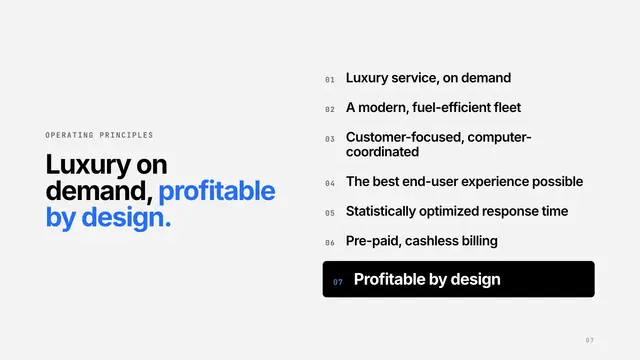
    PrinciplesHow you will run it, ending on the business model.
  8. 08
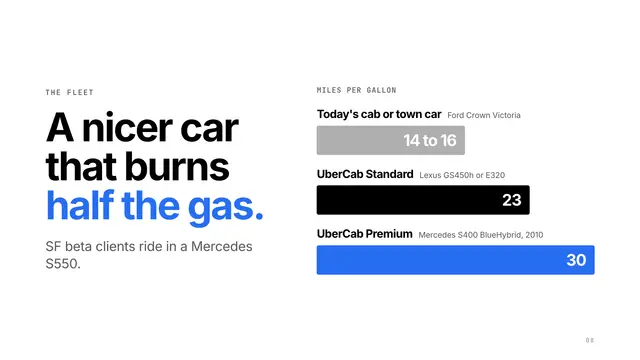
    Unfair detailOne concrete edge, charted: here, the fleet.
  9. 09
    MarketThe number, who holds it, and how it grows.
  10. 10
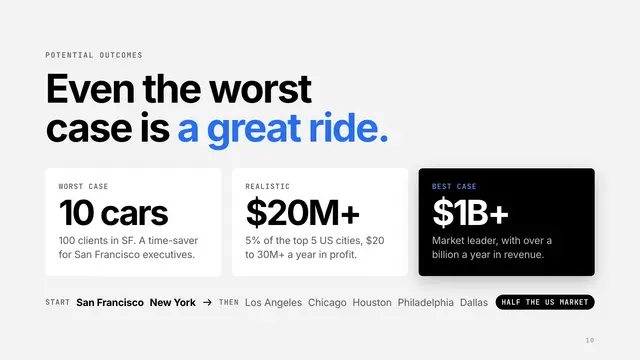
    ScenariosWorst, realistic, best: show the floor is fine.
  11. 11
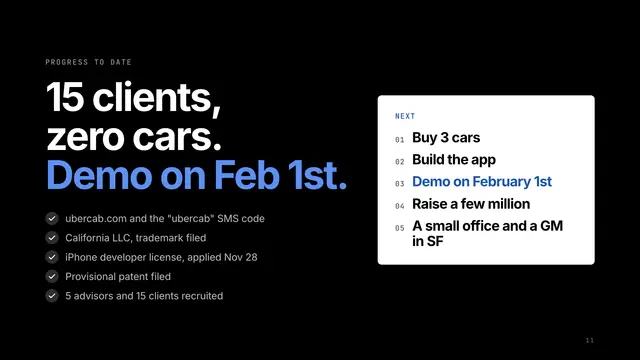
    Progress and nextWhat is done, and the next milestone with a date.
What good pitch decks do, and where they fail
  • Investors skim: DocSend measured about 3.7 minutes per deck, and decks that fail are dropped in about 2. The first two slides decide whether the rest gets read.
  • Every headline is a full-sentence claim, and each beat gets one slide, three at most (Y Combinator).
  • Lead with your strongest proof, traction or team, whichever is stronger.
  • Size the market bottoms-up (customers × price), with the math visible.
  • The ask names an amount, the milestone it buys, and when.
  • Topic-label headlines ("Market", "Team")
  • A top-down TAM with no path to it
  • Traction buried after the product tour
  • An ask with no milestone

Every slide of the Uber pitch deck

Each one opens the live deck at that slide.

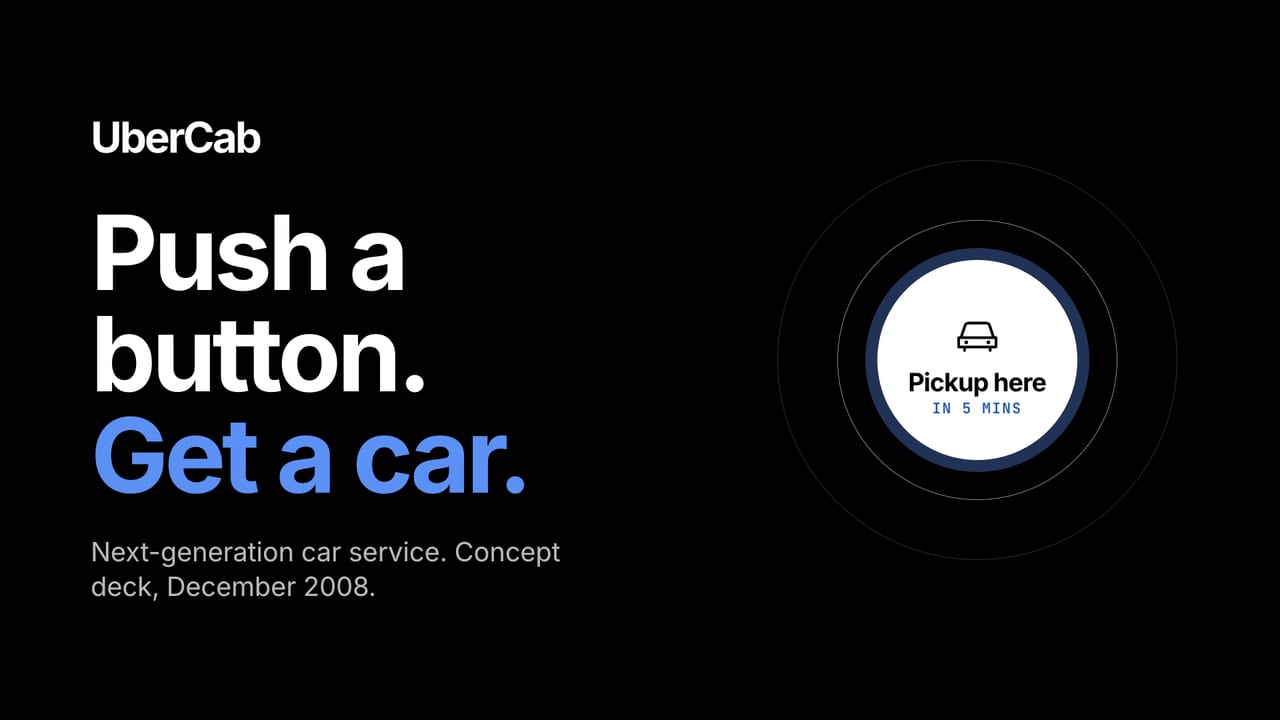
  1. Uber deck, slide 1: Push a button. Get a car. 01Push a button. Get a car.
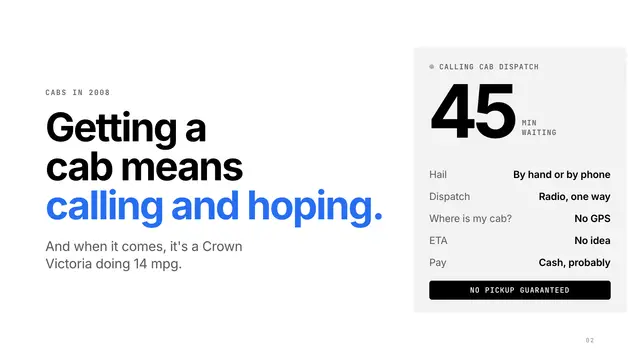
  2. Uber deck, slide 2: Getting a cab means calling and hoping. 02Getting a cab means calling and hoping.
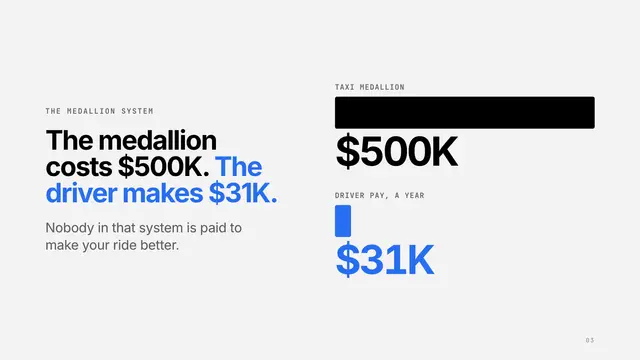
  3. Uber deck, slide 3: The medallion costs $500K. The driver makes $31K. 03The medallion costs $500K. The driver makes $31K.
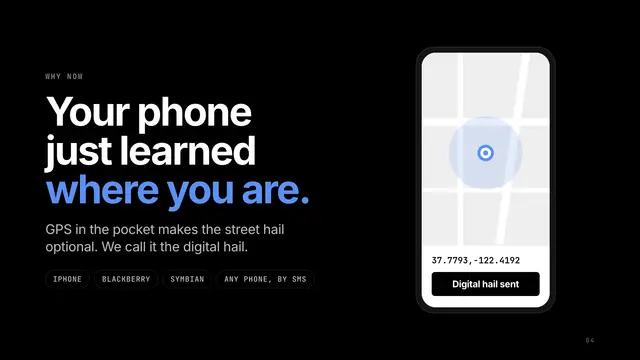
  4. Uber deck, slide 4: Your phone just learned where you are. 04Your phone just learned where you are.
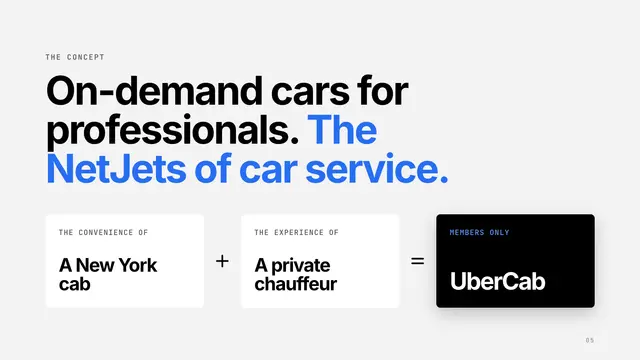
  5. Uber deck, slide 5: On-demand cars for professionals. The NetJets of car service. 05On-demand cars for professionals. The NetJets of car service.
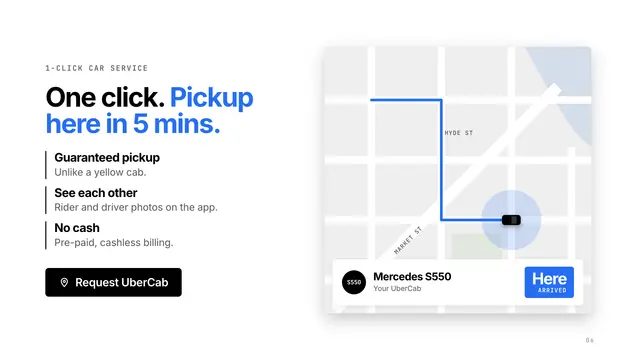
  6. Uber deck, slide 6: One click. Pickup here in 5 mins. 06One click. Pickup here in 5 mins.
  7. Uber deck, slide 7: Luxury on demand, profitable by design. 07Luxury on demand, profitable by design.
  8. Uber deck, slide 8: A nicer car that burns half the gas. 08A nicer car that burns half the gas.
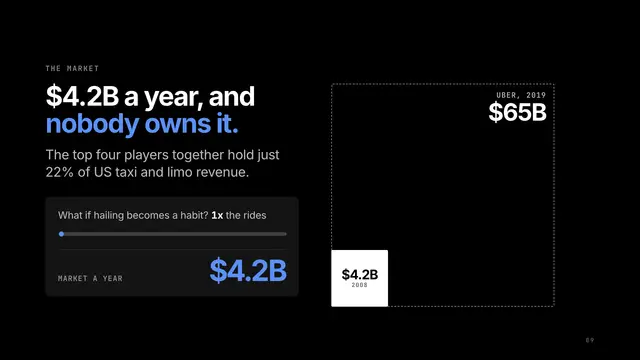
  9. Uber deck, slide 9: $4.2B a year, and nobody owns it. 09$4.2B a year, and nobody owns it.
  10. Uber deck, slide 10: Even the worst case is a great ride. 10Even the worst case is a great ride.
  11. Uber deck, slide 11: 15 clients, zero cars. Demo on Feb 1st. 1115 clients, zero cars. Demo on Feb 1st.
The original, and what the 2026 rebuild changes

The original, 2008, 25 slides

  1. Title: "Next-Generation Car Service"
  2. Cabs in 2008: radio dispatch, 14 mpg, no GPS
  3. The medallion system: $500K medallions, $31K drivers
  4. UberCab concept: "the NetJets of car services"
  5. 1-click car service: members only, guaranteed pickup
  6. Key differentiators and operating principles
  7. Apps, UberCab.com, and use cases
  8. User and environmental benefits
  9. Fleet, initial service area, technology
  10. Demand forecasting
  11. Market: $4.2B, top 4 players hold 22%
  12. Target cities and potential outcomes
  13. Smartphones, Aug 2008
  14. Future optimizations, marketing, location-based services
  15. Progress to date: 15 clients, Feb 1st demo

See the original 2008 deck All 25 slides, on Speaker Deck

What the rebuild changes

  • The product drives itself. Press "Request UberCab" and a car drives the streets of SF to your pin while the ETA counts down from 5. The original described it in bullets.
  • The market slide has a twist. The 2008 headline stays $4.2B. Then drag "what if hailing becomes a habit" toward the dashed square: $65B of 2019 gross bookings.
  • One dispatch call replaces a bullet list. "Cabs in 2008" is a call screen counting to 45 minutes: radio dispatch, no GPS, no ETA, cash.
  • Twenty-five slides became eleven. Use cases, benefits, marketing ideas, and the LBS roadmap folded into the beats that carry the story.

Make yours in ChatGPT

Type your site. We'll write the prompt with Uber's structure and your brand.