
NASA: The moonshot budget

Nine billion dollars to win a race nobody else can see. Budget request, 1961, rebuilt as a live deck you can play and steal. More in Templates, proposals and business cases.

NASA deck, first slide Play the deck
  • 12 slides
  • $531M in year one
  • $7B to $9B over 5 years
  • Deadline: 1969

Steal the budget request structure

12 slides, one job each, in this order. Swap in your story and keep the order.

  1. 01
    CoverThe outcome and the deadline, in one line.
  2. 02
    The decisionThe one decision you need, and the first-year number, before any background.
  3. 03
    Why now: the scoreboardWhere you stand against the competition, counted honestly, with what the market notices marked.
  4. 04
    Why now: the triggerThe recent events that make waiting more expensive than acting, on a timeline.
  5. 05
    Options consideredEvery real alternative, including doing nothing, with cost, timing and odds for each.
  6. 06
    RecommendationThe option you chose and the one insight that makes it winnable.
  7. 07
    Cost and phasingSpend by year, so the approvers see year one and the peak.
  8. 08
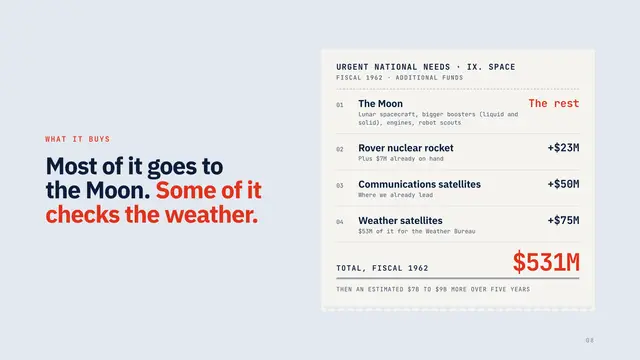
    Line itemsWhat the money buys, itemized like a receipt, totals that match.
  9. 09
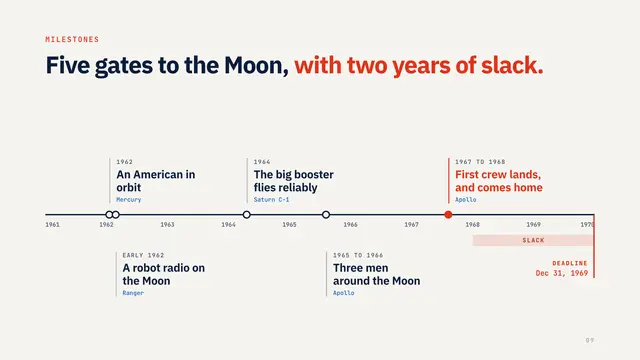
    MilestonesGates with dates, and the slack against the deadline.
  10. 10
    RisksA register with an owner and a mitigation for each risk.
  11. 11
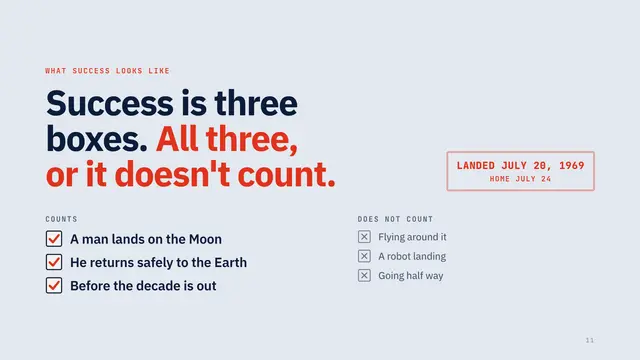
    Success criteriaWhat counts as done, and what explicitly does not.
  12. 12
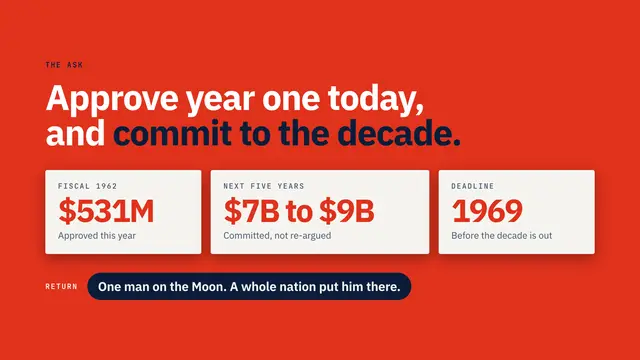
    The askThe numbers to approve, the commitment, and the return.
What good proposals and business cases do, and where they fail
  • Start with their goal in their words, not your company.
  • Check off every requirement in the brief, visibly.
  • Put the decision on the first slide: what you are asking them to approve.
  • Show the options you considered and why this one wins.
  • Cost, phasing, and terms in one place; risks each with an owner; next steps with a date.
  • A credentials deck instead of an answer
  • Missing a requirement from the brief
  • Price hidden or vague
  • No decision asked for

The deck, slide by slide

Each one opens the live deck at that slide.

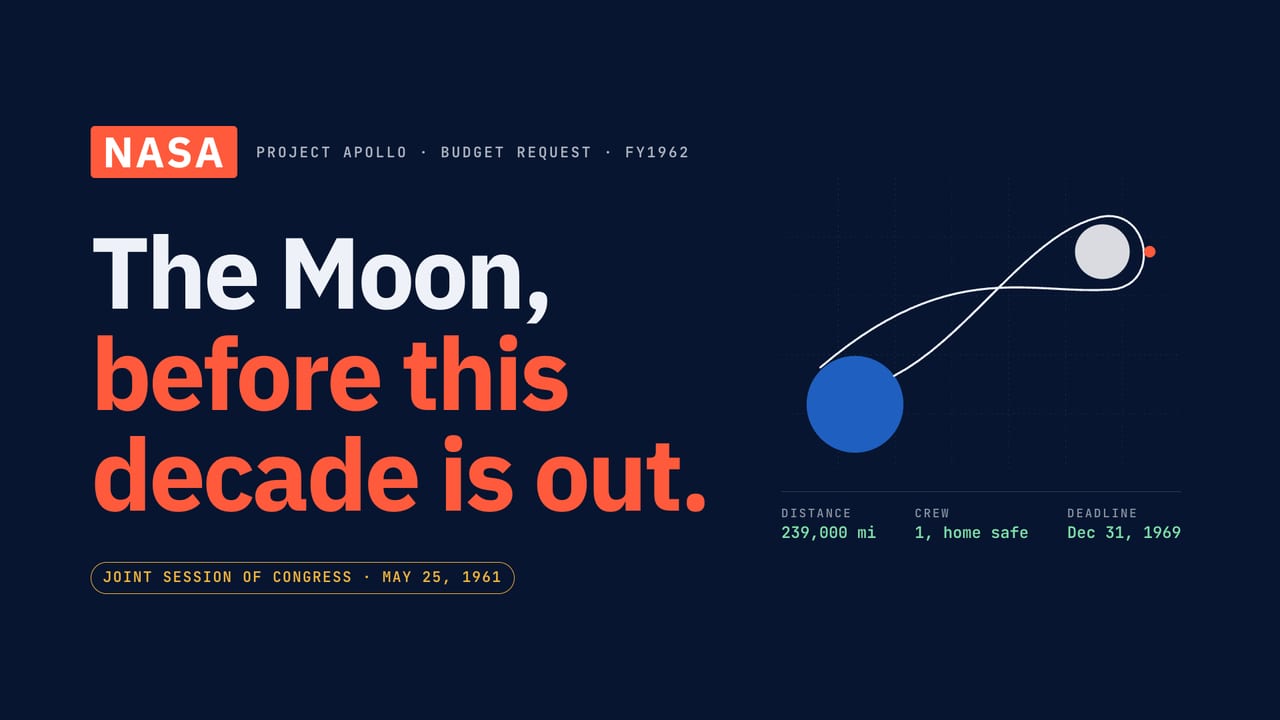
  1. NASA deck, slide 1: The Moon, before this decade is out. 01The Moon, before this decade is out.
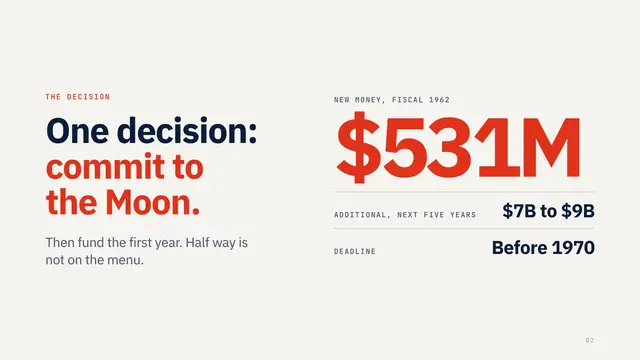
  2. NASA deck, slide 2: One decision: commit to the Moon. 02One decision: commit to the Moon.
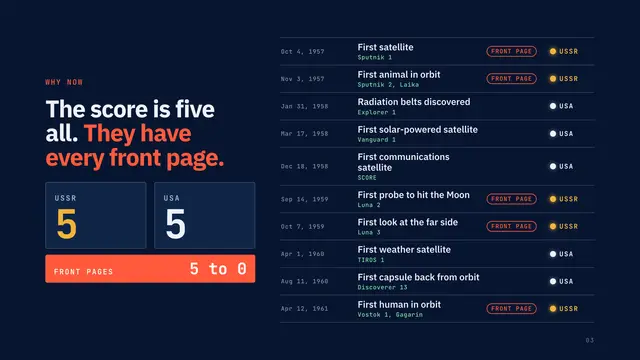
  3. NASA deck, slide 3: The score is five all. They have every front page. 03The score is five all. They have every front page.
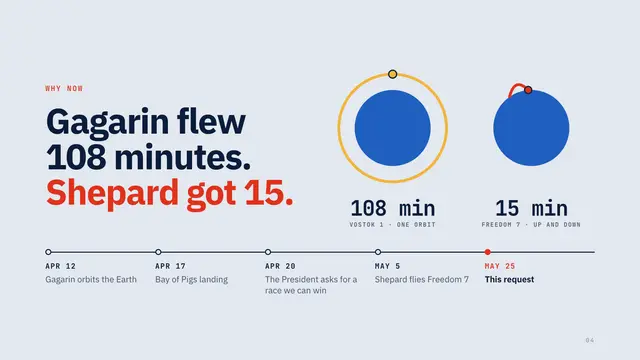
  4. NASA deck, slide 4: Gagarin flew 108 minutes. Shepard got 15. 04Gagarin flew 108 minutes. Shepard got 15.
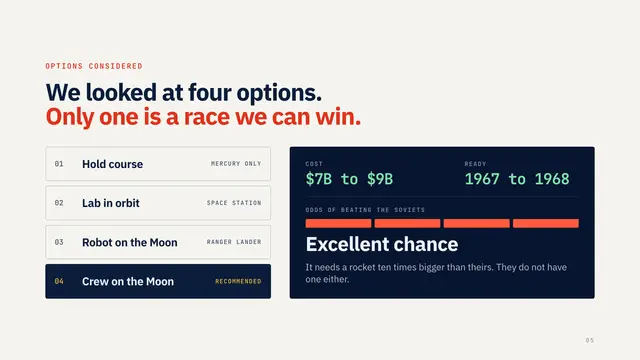
  5. NASA deck, slide 5: We looked at four options. Only one is a race we can win. 05We looked at four options. Only one is a race we can win.
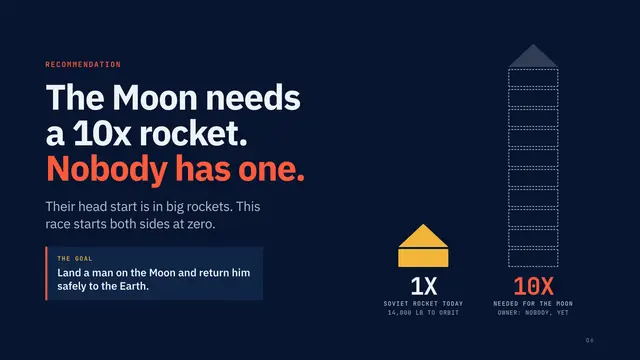
  6. NASA deck, slide 6: The Moon needs a 10x rocket. Nobody has one. 06The Moon needs a 10x rocket. Nobody has one.
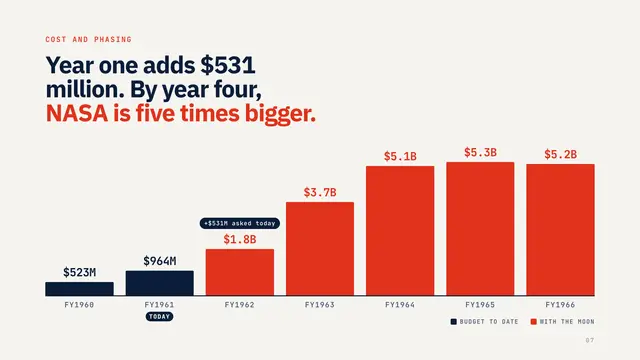
  7. NASA deck, slide 7: Year one adds $531 million. By year four, NASA is five times bigger. 07Year one adds $531 million. By year four, NASA is five times bigger.
  8. NASA deck, slide 8: Most of it goes to the Moon. Some of it checks the weather. 08Most of it goes to the Moon. Some of it checks the weather.
  9. NASA deck, slide 9: Five gates to the Moon, with two years of slack. 09Five gates to the Moon, with two years of slack.
  10. NASA deck, slide 10: Five risks, five owners. Only one of them is Moscow. 10Five risks, five owners. Only one of them is Moscow.
  11. NASA deck, slide 11: Success is three boxes. All three, or it doesn't count. 11Success is three boxes. All three, or it doesn't count.
  12. NASA deck, slide 12: Approve year one today, and commit to the decade. 12Approve year one today, and commit to the decade.
What really happened, and what the 2026 rebuild changes

What really happened, 1961

  1. April 12, 1961: Gagarin orbits the Earth
  2. April 17 to 20: the Bay of Pigs
  3. April 20: Kennedy asks Johnson for a space race the US can win
  4. April 29: von Braun answers: a Moon landing, "an excellent chance"
  5. May 5: Shepard flies 15 minutes, up and down
  6. May 25: Kennedy addresses a joint session of Congress in person
  7. Section IX: land a man on the Moon and return him safely, before the decade is out
  8. Four goals: the Moon, the Rover nuclear rocket, communications and weather satellites
  9. The bill: $531M in fiscal 1962, $7B to $9B more over five years
  10. "If we are to go only half way ... it would be better not to go at all"

Read the real story President Kennedy, Special Message to Congress on Urgent National Needs, via the JFK Library

What the rebuild changes

  • The scoreboard fills in. Ten real firsts from Sputnik to Gagarin light up one by one. The score ends five all. The front pages end five to nothing.
  • Pick your option, see the odds. Toggle hold course, a lab in orbit, a robot on the Moon, or a crew on the Moon, and read the cost, the date and von Braun's own odds for each.
  • The budget draws itself. NASA by fiscal year, 1960 to 1966: year one adds $531 million, and by year four the agency is five times bigger.
  • The receipt itemizes the weather. Rover, communications and weather satellites each get a line. The Moon gets "the rest".

Make yours in ChatGPT

Type your site. We'll write the prompt with NASA's structure and your brand.